  | |
| Observation data Epoch J2000.0 Equinox ICRS | |
|---|---|
| Constellation | Centaurus1 |
| A | |
| Right ascension | 13h 53m 12.53829s2 |
| Declination | −31° 55′ 39.4304″2 |
| Apparent magnitude (V) | +4.723 |
| B | |
| Right ascension | 13h 53m 12.43506s4 |
| Declination | −31° 55′ 54.1506″4 |
| Apparent magnitude (V) | +8.475) |
| Characteristics | |
| A | |
| Evolutionary stage | main sequence2 |
| Spectral type | B6IV6 |
| U−B color index | −0.567 |
| B−V color index | −0.147 |
| B | |
| Evolutionary stage | main sequence4 |
| Spectral type | Am6 |
| U−B color index | +0.108 |
| B−V color index | +0.308 |
| Astrometry | |
| A | |
| Radial velocity (Rv) | +5.2±29 km/s |
| Proper motion (μ) | RA: −10.4282 mas/yr Dec.: −10.7102 mas/yr |
| Parallax (π) | 4.8225±0.1539 mas2 |
| Distance | 680 ± 20 ly (207 ± 7 pc) |
| Absolute magnitude (MV) | −1.661 |
| B | |
| Radial velocity (Rv) | +9±109 km/s |
| Proper motion (μ) | RA: −10.9054 mas/yr Dec.: −10.6254 mas/yr |
| Parallax (π) | 4.1269±0.1312 mas4 |
| Distance | 790 ± 30 ly (242 ± 8 pc) |
| Orbit6 | |
| Primary | 4 Cen Aa |
| Name | 4 Cen Ab |
| Period (P) | 6.930137±0.000015 d |
| Eccentricity (e) | 0.25±0.10 |
| Argument of periastron (ω) (secondary) | 152±17° |
| Semi-amplitude (K1) (primary) | 21.0±1.5 km/s |
| Orbit6 | |
| Primary | 4 Cen Ba |
| Name | 4 Cen Bb |
| Period (P) | 4.8390±0.0001 d |
| Eccentricity (e) | 0.05±0.02 |
| Periastron epoch (T) | 2442916.55±0.09 |
| Argument of periastron (ω) (secondary) | 51±20° |
| Semi-amplitude (K1) (primary) | 16.9±3.5 km/s |
| Details | |
| Aa | |
| Mass | 7.710 M☉ |
| Radius | 6.22 R☉ |
| Luminosity | 68711 L☉ |
| Surface gravity (log g) | 3.432 cgs |
| Temperature | 14,32211 K |
| Metallicity [Fe/H] | −1.062 dex |
| Rotation | 27.2 days12 |
| Age | 5113 Myr |
| Ab | |
| Mass | 0.7510 M☉ |
| Details | |
| Ba | |
| Mass | 1.910 M☉ |
| Radius | 2.4814 R☉ |
| Luminosity | 17.014 L☉ |
| Surface gravity (log g) | 3.8814 cgs |
| Temperature | 7,44014 K |
| Bb | |
| Mass | 0.2210 M☉ |
| Other designations | |
| h Cen, 4 Cen, HD 120955, HR 5221, CCDM J13532-315615 | |
| A: CD−31°10729, GC 18755, HIP 67786, SAO 20494416 | |
| B: CD−31°10727, GC 18754, SAO 20494317 | |
| Database references | |
| SIMBAD | data |
| 4 Cen B | |
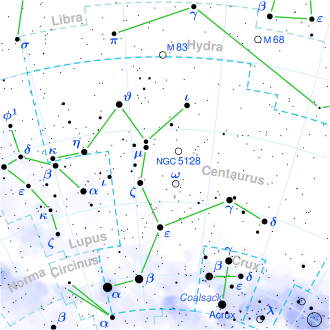
4 Centauri is a multiple star in the constellation Centaurus, approximately 640 light years from Earth. It has a combined apparent magnitude of +4.71.18 The primary is a blue-white B-type subgiant with a spectroscopic companion, while the secondary is an Am star also with a spectroscopic companion.
4 Centauri is a hierarchical quadruple star system. The primary component of the system, 4 Centauri A, is a spectroscopic binary, meaning that its components cannot be resolved but periodic Doppler shifts in its spectrum show that it must be orbiting. 4 Centauri A has an orbital period of 6.927 days and an eccentricity of 0.23. Because light from only one of the stars can be detected (i.e. it is a single-lined spectroscopic binary), some parameters such as its inclination are unknown.19 The secondary component, is also a single-lined spectroscopic binary. It has an orbital period of 4.839 days and an eccentricity of 0.05. The secondary component is a metallic-lined A-type star. The two pairs themselves are separated by 14 arcseconds; one orbit would take at least 55,000 years.6
References
References
- Anderson, E.; Francis, Ch. (2012). "XHIP: An extended hipparcos compilation". Astronomy Letters. 38 (5): 331. arXiv:1108.4971. Bibcode:2012AstL...38..331A. doi:10.1134/S1063773712050015. XHIP record for this object at VizieR.
- Vallenari, A.; et al. (Gaia collaboration) (2023). "Gaia Data Release 3. Summary of the content and survey properties". Astronomy and Astrophysics. 674: A1. arXiv:2208.00211. Bibcode:2023A&A...674A...1G. doi:10.1051/0004-6361/202243940. S2CID 244398875. Gaia DR3 record for this source at VizieR.
- Mason, Brian D.; Wycoff, Gary L.; Hartkopf, William I.; Douglass, Geoffrey G.; Worley, Charles E. (2001). "The 2001 US Naval Observatory Double Star CD-ROM. I. The Washington Double Star Catalog". The Astronomical Journal. 122 (6): 3466. Bibcode:2001AJ....122.3466M. doi:10.1086/323920.
- Vallenari, A.; et al. (Gaia collaboration) (2023). "Gaia Data Release 3. Summary of the content and survey properties". Astronomy and Astrophysics. 674: A1. arXiv:2208.00211. Bibcode:2023A&A...674A...1G. doi:10.1051/0004-6361/202243940. S2CID 244398875. Gaia DR3 record for this source at VizieR.
- Nicolet, B. (1978). "Catalogue of homogeneous data in the UBV photoelectric photometric system". Astronomy and Astrophysics. 34: 1. Bibcode:1978A&AS...34....1N.
- Levato, H.; Malaroda, S.; Morrell, N.; Solivella, G. (1987). "Stellar multiplicity in the Scorpius-Centaurus association". Astrophysical Journal Supplement Series. 64: 487–503. Bibcode:1987ApJS...64..487L. doi:10.1086/191204.
- Mallama, A. (2014). "Sloan Magnitudes for the Brightest Stars". Journal of the American Association of Variable Star Observers (Jaavso). 42 (2): 443. Bibcode:2014JAVSO..42..443M.
- Renson, P.; Manfroid, J. (2009). "Catalogue of Ap, HGMN and Am stars". Astronomy and Astrophysics. 498 (3): 961. Bibcode:2009A&A...498..961R. doi:10.1051/0004-6361/200810788.
- Evans, D. S. (1967). "The Revision of the General Catalogue of Radial Velocities". Determination of Radial Velocities and Their Applications. 30: 57. Bibcode:1967IAUS...30...57E.
- Tokovinin, Andrei (2018). "The Updated Multiple Star Catalog". The Astrophysical Journal Supplement Series. 235 (1): 6. arXiv:1712.04750. Bibcode:2018ApJS..235....6T. doi:10.3847/1538-4365/aaa1a5.
- Quintana, Alexis L.; Wright, Nicholas J.; Martínez García, Juan (2025). "A census of OB stars within 1 KPC and the star formation and core collapse supernova rates of the Milky Way". Monthly Notices of the Royal Astronomical Society. 538 (3): 1367. arXiv:2503.08286. Bibcode:2025MNRAS.538.1367Q. doi:10.1093/mnras/staf083.
- Oelkers, Ryan J.; Rodriguez, Joseph E.; Stassun, Keivan G.; Pepper, Joshua; Somers, Garrett; Kafka, Stella; Stevens, Daniel J.; Beatty, Thomas G.; Siverd, Robert J.; Lund, Michael B.; Kuhn, Rudolf B.; James, David; Gaudi, B. Scott (2018). "Variability Properties of Four Million Sources in the TESS Input Catalog Observed with the Kilodegree Extremely Little Telescope Survey". The Astronomical Journal. 155 (1): 39. arXiv:1711.03608. Bibcode:2018AJ....155...39O. doi:10.3847/1538-3881/aa9bf4.
- Tetzlaff, N.; Neuhäuser, R.; Hohle, M. M. (2011). "A catalogue of young runaway Hipparcos stars within 3 KPC from the Sun". Monthly Notices of the Royal Astronomical Society. 410 (1): 190. arXiv:1007.4883. Bibcode:2011MNRAS.410..190T. doi:10.1111/j.1365-2966.2010.17434.x.
- Stassun, Keivan G.; et al. (2019). "The Revised TESS Input Catalog and Candidate Target List". The Astronomical Journal. 158 (4): 138. arXiv:1905.10694. Bibcode:2019AJ....158..138S. doi:10.3847/1538-3881/ab3467.
- "* 4 Cen". SIMBAD. Centre de données astronomiques de Strasbourg. Retrieved 8 February 2018.
- "* 4 Cen A". SIMBAD. Centre de données astronomiques de Strasbourg. Retrieved 8 February 2018.
- "* 4 Cen B". SIMBAD. Centre de données astronomiques de Strasbourg. Retrieved 8 February 2018.
- Paunzen, E. (2022). "Catalogue of stars measured in the Geneva seven-colour photometric system". Astronomy and Astrophysics. 661: A89. arXiv:2111.04810. Bibcode:2022A&A...661A..89P. doi:10.1051/0004-6361/202142355.
- Paddock, G. F. (1917). "The Spectroscopic Binary H 4 Centauri". Publications of the Astronomical Society of the Pacific. 29 (167): 56. Bibcode:1917PASP...29...56P. doi:10.1086/122588. S2CID 120812946.