  | |
| Observation data Epoch J2000 Equinox J2000 | |
|---|---|
| Constellation | Libra1 |
| Right ascension | 15h 58m 11.36869s2 |
| Declination | −14° 16′ 45.6894″2 |
| Apparent magnitude (V) | 4.951 |
| Characteristics | |
| Evolutionary stage | main sequence3 |
| Spectral type | B3 Vsh45 |
| B−V color index | −0.08±0.111 |
| Variable type | γ Cas6 |
| Astrometry | |
| Radial velocity (Rv) | −7.5±1.87 km/s |
| Proper motion (μ) | RA: −12.442 mas/yr Dec.: −16.732 mas/yr |
| Parallax (π) | 6.97±0.24 mas2 |
| Distance | 470 ± 20 ly (143 ± 5 pc) |
| Absolute magnitude (MV) | −0.831 |
| Details | |
| Mass | 6.075 M☉ |
| Radius | 4.125 R☉ |
| Luminosity | 1,1005 L☉ |
| Surface gravity (log g) | 3.71±0.048 cgs |
| Temperature | 18,000±1808 K |
| Rotation | 9.6 hours9 |
| Rotational velocity (v sin i) | 4005 km/s |
| Age | 1010 Myr |
| Other designations | |
| 48 Lib, FX Lib, AAVSO 1552-14, BD−13°4302, FK5 1417, HD 142983, HIP 78207, HR 5941, SAO 15960711 | |
| Database references | |
| SIMBAD | data |
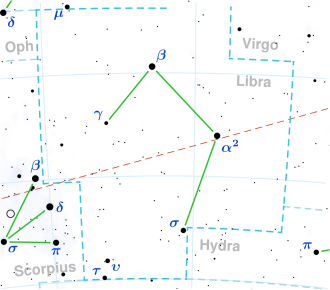
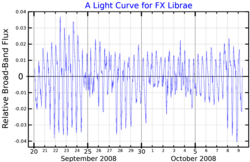
48 Librae is a single5 shell star in the constellation Libra. It is a variable star with the designation FX Lib, ranging in magnitude from 4.74 to 4.96.6 Based upon an annual parallax shift of 6.97±0.24 mas as seen from Earth's orbit, it is located approximately 470 light years from the Sun. It is a candidate member of the Upper Scorpius group of the Scorpius–Centaurus association, with the former having an age of about 11 million years.12
This is a main sequence Be star with a stellar classification of B3 Vsh,4 although it has been variously classed as B3V, B5IIIp shell He-n, B6p shell, B4III, B3IV:e-shell, and B3 shell by different sources. As is the norm for a shell star, it is spinning very rapidly with a projected rotational velocity of 400 km/s − matching or exceeding 80% of the critical velocity.5 This is giving the star a pronounced oblate shape with an equatorial bulge that is estimated to be 43% larger than the polar radius.13 It has six times the mass of the Sun and four times the Sun's radius. The star is radiating 1,1005 times the Sun's luminosity from its photosphere at an effective temperature of 18,000 K.8
The surrounding gaseous disk stretches out to at least 1514 times the star's radius and is nearly aligned with the line of sight from the Earth, having an estimated inclination of 85°±3°.5 Some time between 1931 and 1935, the disk became active and has remained so since that time, becoming the subject of multiple studies.15 The unusual asymmetry in its emission lines have led to it being misclassified as a supergiant of type B8 Ia/Ib by SIMBAD and others. This asymmetry displays quasi-periodic behavior of the type found in about a third of all Be stars, with a period of about 10 to 17 years. This variation may arise from the precession of a one-armed density wave in the disk.5
The Bayer designation Phi Scorpii has been associated with this star. No star is found at the position marked φ Scorpii in Johann Bayer's Uranometria.16 The closest stars to that position are 48 and 49 Librae; 48 Librae is clearly shown but not given a designation while no star is shown at the position of 49 Librae. In his Uranographia Bode assigned the designation φ Scorpii to the star now known as 49 Librae.17 The designation is no longer in use.18
References
References
- Anderson, E.; Francis, Ch. (2012). "XHIP: An extended hipparcos compilation". Astronomy Letters. 38 (5): 331. arXiv:1108.4971. Bibcode:2012AstL...38..331A. doi:10.1134/S1063773712050015. XHIP record for this object at VizieR.
- van Leeuwen, F. (2007), "Validation of the new Hipparcos reduction", Astronomy and Astrophysics, 474 (2): 653–664, arXiv:0708.1752, Bibcode:2007A&A...474..653V, doi:10.1051/0004-6361:20078357, S2CID 18759600.
- Vallenari, A.; et al. (Gaia collaboration) (2023). "Gaia Data Release 3. Summary of the content and survey properties". Astronomy and Astrophysics. 674: A1. arXiv:2208.00211. Bibcode:2023A&A...674A...1G. doi:10.1051/0004-6361/202243940. S2CID 244398875. Gaia DR3 record for this source at VizieR.
- Rivinius, Thomas; et al. (2013), "Classical Be stars. Rapidly rotating B stars with viscous Keplerian decretion disks", The Astronomy and Astrophysics Review, 21: 69, arXiv:1310.3962, Bibcode:2013A&ARv..21...69R, doi:10.1007/s00159-013-0069-0, S2CID 118652497.
- Silaj, J.; et al. (July 2016), "Investigating the Circumstellar Disk of the Be Shell Star 48 Librae", The Astrophysical Journal, 826 (1): 11, arXiv:1608.00943, Bibcode:2016ApJ...826...81S, doi:10.3847/0004-637X/826/1/81, S2CID 119112873, 81.
- Samus, N. N.; et al. (2017), "General Catalogue of Variable Stars", Astronomy Reports, GCVS 5.1, 61 (1): 80–88, Bibcode:2017ARep...61...80S, doi:10.1134/S1063772917010085, S2CID 125853869.
- de Bruijne, J. H. J.; Eilers, A.-C. (October 2012), "Radial velocities for the HIPPARCOS-Gaia Hundred-Thousand-Proper-Motion project", Astronomy & Astrophysics, 546: 14, arXiv:1208.3048, Bibcode:2012A&A...546A..61D, doi:10.1051/0004-6361/201219219, S2CID 59451347, A61.
- Arcos, C.; Kanaan, S.; Chávez, J.; Vanzi, L.; Araya, I.; Curé, M. (2018), "Stellar parameters and H α line profile variability of be stars in the BeSOS survey", Monthly Notices of the Royal Astronomical Society, 474 (4): 5287, arXiv:1711.08675, Bibcode:2018MNRAS.474.5287A, doi:10.1093/mnras/stx3075.
- Ozuyar, D.; Caliskan, S.; Stevens, I. R.; Elmasli, A. (November 2018). "Photometric and spectroscopic variability of the Be star 48 Lib: The relation between photometric variations and rotation". Publications of the Astronomical Society of Australia. 35 e034. Bibcode:2018PASA...35...34O. doi:10.1017/pasa.2018.38. S2CID 126232532.
- Squicciarini, V.; Mazoyer, J.; Lagrange, A. -M.; Chomez, A.; Delorme, P.; Flasseur, O.; Kiefer, F.; Bergeon, S.; Albert, D.; Meunier, N. (2025). "The COBREX archival survey: Improved constraints on the occurrence rate of wide-orbit substellar companions: I. A uniform re-analysis of 400 stars from the GPIES survey". Astronomy and Astrophysics. 693. arXiv:2411.06157. Bibcode:2025A&A...693A..54S. doi:10.1051/0004-6361/202452310.
- "48 Lib". SIMBAD. Centre de données astronomiques de Strasbourg. Retrieved 2018-03-04.
- Jang-Condell, Hannah; et al. (August 2015), "Spitzer IRS Spectra of Debris Disks in the Scorpius–Centaurus OB Association", The Astrophysical Journal, 808 (2): 19, arXiv:1506.05428, Bibcode:2015ApJ...808..167J, doi:10.1088/0004-637X/808/2/167, S2CID 118549483, 167.
- van Belle, Gerard T. (March 2012), "Interferometric observations of rapidly rotating stars", The Astronomy and Astrophysics Review, 20 (1) 51, arXiv:1204.2572, Bibcode:2012A&ARv..20...51V, doi:10.1007/s00159-012-0051-2, S2CID 119273474.
- Štefl, S.; et al. (April 2012), "New activity in the large circumstellar disk of the Be-shell star 48 Librae", Astronomy & Astrophysics, 540: 12, arXiv:1202.4523, Bibcode:2012A&A...540A..76S, doi:10.1051/0004-6361/201118054, S2CID 54663995, A76
- Faraggiana, R. (June 1969), "A study of 48 Librae in the period 1950 - 1962", Astronomy and Astrophysics, 2: 162, Bibcode:1969A&A.....2..162F.
- Bayer, Johann; Mair, Alexander (1603). Uranometria (in Latin). Excvdit Christophorvs Mangvs. Retrieved 2025-11-10.
- Ian Ridpath. "Scorpius". Star Tales. Retrieved 2025-09-10.
- "Chi and Psi Scorpii", stars.astro.illinois.edu, retrieved 2025-07-13.