| 3C 66A | |
|---|---|
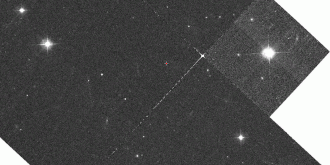 Hubble Legacy Archive WFPC2 image of 3C 66A (brightest object on the far right) | |
| Observation data (Epoch J2000) | |
| Constellation | Andromeda |
| Right ascension | 02h 22m 39.612s1 |
| Declination | +43° 02′ 07.80″1 |
| Redshift | 0.44412 |
| Distance | 4.5 billion light-years (Light travel time)2 5.4 billion light-years (present)2 |
| Type | BLLAC2 |
| Apparent magnitude (V) | 15.512 |
| Other designations | |
| 2E 558, 2EG J0220+4228, B3 0219+428A, QSO B0219+42481 | |
| See also: Quasar, List of quasars | |
3C 66A is a blazar12 located in the constellation Andromeda.
The "distance" of a far away galaxy depends on the distance measurement used. With a redshift of 0.444,12 light from this active galaxy is estimated to have taken around 4.5 billion years to reach Earth.2 But as a result of the expansion of the Universe, the present (co-moving) distance to this galaxy is about 5.4 billion light-years (1647 Mpc).2 Even at this great distance this blazar has an apparent magnitude of about 15.5.1 Although 0.444 is used as the common redshift value, 0.3347 is a new strict lower limit "inferred through observing the far-UV absorption by the low-z IGM."3
3C 66A underwent an optical outburst in 2007 August, as monitored by the Tuorla blazar monitoring program.4 The event was monitored by the Whole Earth Blazar Telescope project.
References
References
- "3C 66A". SIMBAD Astronomical Database. Retrieved 2010-04-01.
- "NASA/IPAC Extragalactic Database". Results for 3C 066A. Retrieved 2010-04-01.
- Furniss, Amy (May 10, 2013). "THE FIRM REDSHIFT LOWER LIMIT OF THE MOST DISTANT TeV-DETECTED BLAZAR PKS 1424+240". Astrophysical Journal Letters. 768 (2): L31. arXiv:1304.4859. Bibcode:2013ApJ...768L..31F. doi:10.1088/2041-8205/768/2/L31. S2CID 21291053.
- Errando, Manel; Lindfors, Elina; Mazin, Daniel; Prandini, Elisa; Tavecchio, Fabrizio (2009). "A TeV source in the 3C 66A/B region". arXiv:0907.0994 [astro-ph.HE].