  | |
| Observation data Epoch J2000 Equinox J2000 | |
|---|---|
| Constellation | Lynx |
| Right ascension | 09h 13m 48.21318s1 |
| Declination | +43° 13′ 04.1940″1 |
| Apparent magnitude (V) | 5.302 |
| Characteristics | |
| Evolutionary stage | main sequence31 |
| Spectral type | B9IVpHgMn4 |
| B−V color index | −0.130±0.0032 |
| Variable type | SX Ari5 |
| Astrometry | |
| Radial velocity (Rv) | 21.3±1.72 km/s |
| Proper motion (μ) | RA: −30.2361 mas/yr Dec.: −32.0321 mas/yr |
| Parallax (π) | 5.2687±0.1577 mas1 |
| Distance | 620 ± 20 ly (190 ± 6 pc) |
| Absolute magnitude (MV) | −0.952 |
| Details | |
| Mass | 4.21 M☉ |
| Radius | 3.43 R☉ |
| Luminosity | 5051 L☉ |
| Surface gravity (log g) | 3.656 cgs |
| Temperature | 13,7006 K |
| Metallicity [Fe/H] | +0.606 dex |
| Rotation | 3.83476±0.00004 d7 |
| Rotational velocity (v sin i) | 49±17 km/s |
| Age | 79-1103 Myr |
| Other designations | |
| 36 Lyn, EI Lyn, BD+43°1893, FK5 346, HD 79158, HIP 45290, HR 3652, SAO 427598 | |
| Database references | |
| SIMBAD | data |
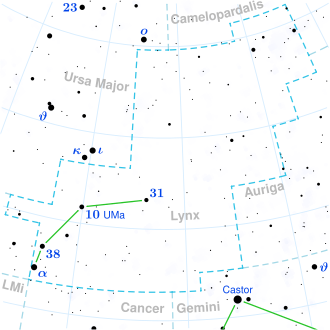
36 Lyncis is a solitary10 variable star located around 620 light years away from the Sun in the northern constellation of Lynx. It has the variable star designation of EI Lyncis, while 36 Lyncis is the Flamsteed designation. This object is visible to the naked eye as a dim, blue-white hued star with an apparent visual magnitude of 5.30.2 It is moving further away from the Earth with a heliocentric radial velocity of 21 km/s.2
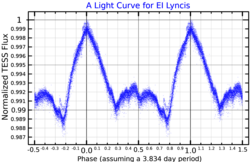
This is a magnetic, helium-weak Bp star1112 with a stellar classification of B9IVpHgMn,4 although the spectral peculiarities have led to alternate classifications such as B8 IIImnp.7 It is sometimes classified as a mercury-manganese star.13 It is also an 'sn' star, displaying a spectrum with generally sharp lines for most elements in combination with broad, diffuse lines of helium.14 36 Lyncis has been classified as an SX Arietis variable15 with an amplitude of 0.03 in visual magnitude and a rotationally-modulated period of 3.834 days.5 The star is spinning with a projected rotational velocity of 49 km/s7 and a rotation rate of 3.83476 days.7 It has 3.4 times the Sun's radius3 and is radiating 505 times the luminosity of the Sun from its photosphere at an effective temperature of 13,700 K.6
References
References
- Vallenari, A.; et al. (Gaia collaboration) (2023). "Gaia Data Release 3. Summary of the content and survey properties". Astronomy and Astrophysics. 674: A1. arXiv:2208.00211. Bibcode:2023A&A...674A...1G. doi:10.1051/0004-6361/202243940. S2CID 244398875. Gaia DR3 record for this source at VizieR.
- Anderson, E.; Francis, Ch. (2012). "XHIP: An extended hipparcos compilation". Astronomy Letters. 38 (5): 331. arXiv:1108.4971. Bibcode:2012AstL...38..331A. doi:10.1134/S1063773712050015. S2CID 119257644.
- Shultz, M. E.; Wade, G. A.; Rivinius, Th; Alecian, E.; Neiner, C.; Petit, V.; Owocki, S.; Ud-Doula, A.; Kochukhov, O.; Bohlender, D.; Keszthelyi, Z.; MiMeS Collaboration; BinaMIcS Collaboration (2019). "The magnetic early B-type stars - III. A main-sequence magnetic, rotational, and magnetospheric biography". Monthly Notices of the Royal Astronomical Society. 490 (1): 274. arXiv:1909.02530. Bibcode:2019MNRAS.490..274S. doi:10.1093/mnras/stz2551.
- Abt, Helmut A.; Morrell, Nidia I. (July 1995). "The Relation between Rotational Velocities and Spectral Peculiarities among A-Type Stars". The Astrophysical Journal Supplement Series. 99: 135. Bibcode:1995ApJS...99..135A. doi:10.1086/192182. ISSN 0067-0049.
- Samus, N. N.; et al. (2017). "General Catalogue of Variable Stars". Astronomy Reports. 5.1. 61 (1): 80–88. Bibcode:2017ARep...61...80S. doi:10.1134/S1063772917010085. S2CID 125853869.
- Ghazaryan, S.; et al. (November 2018). "New catalogue of chemically peculiar stars, and statistical analysis". Monthly Notices of the Royal Astronomical Society. 480 (3): 2953–2962. arXiv:1807.06902. Bibcode:2018MNRAS.480.2953G. doi:10.1093/mnras/sty1912. S2CID 119062018.
- Cowley, A. (November 1972). "Spectral classification of the bright B8 stars". Astronomical Journal. 77: 750–755. Bibcode:1972AJ.....77..750C. doi:10.1086/111348.
- "36 Lyncis". SIMBAD. Centre de données astronomiques de Strasbourg. Retrieved 2019-06-06.
- "MAST: Barbara A. Mikulski Archive for Space Telescopes". Space Telescope Science Institute. Retrieved 8 December 2021.
- Eggleton, P. P.; Tokovinin, A. A. (September 2008). "A catalogue of multiplicity among bright stellar systems". Monthly Notices of the Royal Astronomical Society. 389 (2): 869–879. arXiv:0806.2878. Bibcode:2008MNRAS.389..869E. doi:10.1111/j.1365-2966.2008.13596.x. S2CID 14878976.
- Oksala, M. E.; Silvester, J.; Kochukhov, O.; Neiner, C.; Wade, G. A.; MiMeS Collaboration (January 2018). "Mixed poloidal-toroidal magnetic configuration and surface abundance distributions of the Bp star 36 Lyn". Monthly Notices of the Royal Astronomical Society. 473 (3): 3367–3376. arXiv:1709.08361. Bibcode:2018MNRAS.473.3367O. doi:10.1093/mnras/stx2487. S2CID 4158836.
- Adelman, Saul J. (May 2000). "UVBY photometry of the magnetic CP stars HD 36668, 36 Lyncis, HD 86592, and HR 8861". Astronomy and Astrophysics. 357: 548–552. Bibcode:2000A&A...357..548A.
- Ghazaryan, S.; Alecian, G.; Hakobyan, A. A. (2018). "New catalogue of chemically peculiar stars, and statistical analysis". Monthly Notices of the Royal Astronomical Society. 480 (3): 2953–2962. arXiv:1807.06902. Bibcode:2018MNRAS.480.2953G. doi:10.1093/mnras/sty1912. S2CID 119062018.
- Shore, Steven N.; et al. (September 1987). "The SN Stars: Magnetically Controlled Stellar Winds Among the Helium-Weak Stars". Astronomical Journal. 94: 737. Bibcode:1987AJ.....94..737S. doi:10.1086/114512.
- Watson, Christopher (4 January 2010). "EI Lyncis". AAVSO Website. American Association of Variable Star Observers. Retrieved 21 October 2022.