  | |
| Observation data Epoch J2000 Equinox J2000 | |
|---|---|
| Constellation | Ophiuchus |
| Right ascension | 17h 01m 03.60142s1 |
| Declination | −04° 13′ 21.5308″1 |
| Apparent magnitude (V) | 4.822 |
| Characteristics | |
| Spectral type | K4III3 |
| U−B color index | +1.804 |
| B−V color index | +1.484 |
| Variable type | none5 |
| Astrometry | |
| Radial velocity (Rv) | −6.706 km/s |
| Proper motion (μ) | RA: −39.137 mas/yr Dec.: −78.097 mas/yr |
| Parallax (π) | 9.3138±0.1676 mas1 |
| Distance | 350 ± 6 ly (107 ± 2 pc) |
| Absolute magnitude (MV) | −0.652 |
| Details | |
| Radius | 35.89+0.54 −2.121 R☉ |
| Luminosity | 299.8±6.21 L☉ |
| Surface gravity (log g) | 1.738 cgs |
| Temperature | 4,009.00+126.67 −29.671 K |
| Metallicity [Fe/H] | −0.032 dex |
| Rotational velocity (v sin i) | 1.49 km/s |
| Other designations | |
| 30 Oph, NSV 8111, BD−04°4215, FK5 1445, GC 22937, HD 153687, HIP 83262, HR 6318, SAO 141483, CCDM J17011-0413A, WDS J17011-0413A10 | |
| Database references | |
| SIMBAD | data |
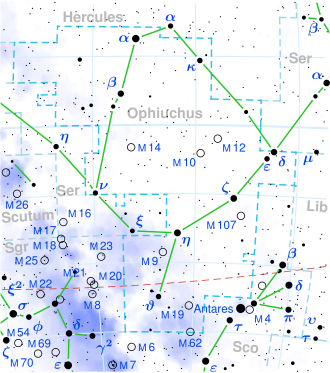
30 Ophiuchi is a single11 star in the equatorial constellation of Ophiuchus, and figures 0.99° east (specifically E½S) of the heart of cluster Messier 10.12 It is visible to the naked eye as a faint, orange-hued point of light with an apparent visual magnitude of 4.82.2 The distance to this star is approximately 350 light years based on parallax.7 Its present motion is, net, one of approaching rather than parting, at −6.7 km/s, its "radial velocity".6
This is an aging giant star with a stellar classification of K4III,3 having exhausted the supply of hydrogen at its core and expanded to 361 times the Sun's radius. The star is radiating 3001 times the luminosity of the Sun from its swollen photosphere at an effective temperature of 4,009 K.1 It is emitting a far infrared excess due to circumstellar dust,13 which extends out to a diameter of 240 AU and has a mass of 62×1025 g.14
The primary presents with two visual companions: B, at magnitude 9.71 and separation 99.8″, and C, at magnitude 8.75 and separation 220.9″ (3′ 40.9″).15
References
References
- Brown, A. G. A.; et al. (Gaia collaboration) (August 2018). "Gaia Data Release 2: Summary of the contents and survey properties". Astronomy & Astrophysics. 616. A1. arXiv:1804.09365. Bibcode:2018A&A...616A...1G. doi:10.1051/0004-6361/201833051. Gaia DR2 record for this source at VizieR.
- Anderson, E.; Francis, Ch. (2012). "XHIP: An extended hipparcos compilation". Astronomy Letters. 38 (5): 331. arXiv:1108.4971. Bibcode:2012AstL...38..331A. doi:10.1134/S1063773712050015. S2CID 119257644. Vizier catalog entry
- Hoffleit, D.; Warren, W. H. (1995). "VizieR Online Data Catalog: Bright Star Catalogue, 5th Revised Ed. (Hoffleit+, 1991)". VizieR On-line Data Catalog: V/50. Originally Published in: 1964BS....C......0H. 5050. Bibcode:1995yCat.5050....0H.
- Mallama, A. (2014). "Sloan Magnitudes for the Brightest Stars". The Journal of the American Association of Variable Star Observers. 42 (2): 443. Bibcode:2014JAVSO..42..443M.Vizier catalog entry
- Samus, N. N.; et al. (2017). "General Catalogue of Variable Stars". Astronomy Reports. 5.1. 61 (1): 80–88. Bibcode:2017ARep...61...80S. doi:10.1134/S1063772917010085. S2CID 125853869.
- Gontcharov, G. A. (2006). "Pulkovo Compilation of Radial Velocities for 35 495 Hipparcos stars in a common system". Astronomy Letters. 32 (11): 759–771. arXiv:1606.08053. Bibcode:2006AstL...32..759G. doi:10.1134/S1063773706110065. S2CID 119231169.
- Van Leeuwen, F. (2007). "Validation of the new Hipparcos reduction". Astronomy and Astrophysics. 474 (2): 653–664. arXiv:0708.1752. Bibcode:2007A&A...474..653V. doi:10.1051/0004-6361:20078357. S2CID 18759600. Vizier catalog entry
- Soubiran, Caroline; Le Campion, Jean-François; Brouillet, Nathalie; Chemin, Laurent (2016). "The PASTEL catalogue: 2016 version". Astronomy & Astrophysics. 591: A118. arXiv:1605.07384. Bibcode:2016A&A...591A.118S. doi:10.1051/0004-6361/201628497. S2CID 119258214.
- De Medeiros, J. R.; Alves, S.; Udry, S.; Andersen, J.; Nordström, B.; Mayor, M. (2014). "A catalog of rotational and radial velocities for evolved stars". Astronomy & Astrophysics. 561: A126. arXiv:1312.3474. Bibcode:2014A&A...561A.126D. doi:10.1051/0004-6361/201220762. S2CID 54046583. Vizier catalog entry
- "30 Oph". SIMBAD. Centre de données astronomiques de Strasbourg. Retrieved 2019-06-19.
- Eggleton, P. P.; Tokovinin, A. A. (September 2008). "A catalogue of multiplicity among bright stellar systems". Monthly Notices of the Royal Astronomical Society. 389 (2): 869–879. arXiv:0806.2878. Bibcode:2008MNRAS.389..869E. doi:10.1111/j.1365-2966.2008.13596.x. S2CID 14878976.
- O'Meara, Stephen James (1998). Deep-Sky Companions: The Messier Objects. Cambridge University Press. p. 63. ISBN 9780521553322.
- Zuckerman, B.; et al. (June 1995). "Luminosity Class III Stars with Excess Far-Infrared Emission". Astrophysical Journal Letters. 446: L79. Bibcode:1995ApJ...446L..79Z. doi:10.1086/187935.
- Jura, M. (April 1999). "Dust around First-Ascent Red Giants". The Astrophysical Journal. 515 (2): 706–711. Bibcode:1999ApJ...515..706J. doi:10.1086/307064.
- Mason, Brian D.; Wycoff, Gary L.; Hartkopf, William I.; Douglass, Geoffrey G.; Worley, Charles E. (2001). "The 2001 US Naval Observatory Double Star CD-ROM. I. The Washington Double Star Catalog". The Astronomical Journal. 122 (6): 3466. Bibcode:2001AJ....122.3466M. doi:10.1086/323920. Vizier catalog entry