| Summit Conference of Heads of State or Government of the Non-Aligned Movement | |
|---|---|
 | |
| Host country |  United Arab Republic United Arab Republic |
| Date | 5–10 October 1964 |
| Cities | Cairo |
| Participants |  Afghanistan Afghanistan
 Northern Rhodesia Northern Rhodesia |
| Chair | Gamal Abdel Nasser (President of Egypt) |
| Follows | 1st Summit (Belgrade,  Yugoslavia) Yugoslavia) |
| Precedes | 3rd Summit (Lusaka,  Zambia) Zambia) |


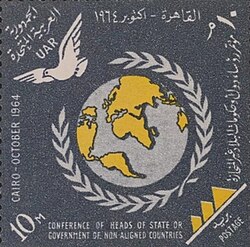
Second Summit Conference of Heads of State or Government of the Non-Aligned Movement on 5–10 October 1964 in Cairo, United Arab Republic (Egypt) was the second conference of the Non-Aligned Movement which followed the Belgrade Conference of 1961 and preceded the Lusaka Conference of 1970. Cairo was selected as the host city at the preparatory meeting held in Colombo, Ceylon, on March 23, 1964.1 At the beginning of the conference, the chairmanship of the movement was transferred from the President of Yugoslavia Josip Broz Tito to the President of Egypt Gamal Abdel Nasser.2
In his opening remarks, Nasser commented on the shifting international context since the first summit in Belgrade in 1961.3 He said non-alignment is not the third bloc but instead opposition to bloc divisions, and is active rather than passive policy. He called for the abolition of direct and hidden imperialism, action on socio-economic inequalities, and prevention of future obstructions by major powers to colonies negotiating their independence.3
President of Indonesia Sukarno commented on peaceful coexistence among major powers, whose direct confrontation would lead to mutual destruction.3 He nevertheless noted the stagnant or even worsening security situation for developing countries, particularly in Southeast Asia, Middle East, Cyprus, Congo and Latin America.3 President of Yugoslavia Josip Broz Tito welcomed the participation of new countries, which he believed would lead to a widening support for non-alignment, peace and coexistence.3 He called for a strengthening of international peace and definitive abolition of colonialism, international disarmament and more equal development.3 President of Ghana Kwame Nkrumah identified four major causes of internal tensions: the division of Germany and Berlin; anticolonial liberation struggles; Cold War ideological divisions; and the superpower arms race.3 The Prime Minister of India underlined five steps for non-aligned action, including nuclear disarmament, peaceful resolution of border disputes, freedom from foreign domination, aggression, subversion and racial discrimination, faster development, and full support for the United Nations.3 The President of Revolutionary Government of Angola in Exile Holden Roberto stated that there can be no peace in a country whose people are exposed to oppression.3
Issues discussed
Universalist and Regionalist approach to membership
One of the prominent issues resolved at the Cairo conference was membership criteria for the movement. Yugoslavia advocated for a universalist approach, in which the movement would be open to all the non-aligned countries regardless of geography, notably in Europe and Latin America. Indonesia advocated for a narrower Afro-Asian regionalism.4 This approach, strongly supported by China, was intended to present the movement as a continuation of the Bandung Conference.4
At the time, the two approaches competed with an Indonesian-Chinese plan to organize the Second Bandung Conference in late 1963 or early 1964 and an Indian, Egyptian and Yugoslav plan for the second Non-Aligned conference.4 Indonesia and China strongly criticized the idea of the Non-Aligned conference as counterproductive to Bandung, whilst Prime Minister of Sri Lanka Sirimavo Bandaranaike confronted those criticisms by stressing the indivisibility of world peace.4 The situation created parallelism in initiatives with preparatory meeting for the Second Non-Aligned Summit taking place in Colombo and the Second Bandung preparatory meeting taking place with delay in Jakarta.4
The Second Bandung preparatory meeting was ultimately supported by only Ghana, Iran, Cambodia, Guinea and Mali (Cambodia, Guinea and Mali supported both initiatives).4 Participants of the second Bandung preparatory meeting proposed that the second meeting should take place in Africa on 10 March 1965 in a country determined by the Organization of African Unity, but it never took place due to Sino-Soviet split and 1965 Algerian coup d'état.54
Participants
57 countries participated in the summit, 10 of which had the observer status.3 All 25 countries participating in the Belgrade Conference were invited to attend the conference in Cairo as well as all Charter of the Organization of African Unity parties, Arab countries in attendance of the 1964 Arab League Summit as well as Malawi, Laos, Jamaica, Trinidad and Tobago, Argentina, Bolivia, Brazil, Chile, Mexico, Uruguay, Venezuela, Austria, Finland, and Sweden. The invitations for Zambia and British Guiana were conditioned on their declaration of independence by October 1964.1 The provisional government of Holden Roberto and other African provisional governments were invited as well.1 26 countries were represented by their respective head of state and 10 by head of government.3
Member States
The following countries participated as full member states.6
- Afghanistan (Mohammed Yusuf, Prime Minister of Afghanistan3)
 Algeria (Ahmed Ben Bella, President of Algeria3)
 Angola (Holden Roberto, President of the Revolutionary Government of Angola in Exile3)
 Burma (U Ti Han, Foreign Affairs Minister3)
 Burundi (Albin Nyamoya, Prime Minister of Burundi3)
 Cambodia (Norodom Kantol, President of the Royal Government3)
 Cameroon (Ahmadou Ahidjo, President of Cameroon3)
 Central African Republic (Marcel Douzima: State Secretary3)
 Ceylon (Sirimavo Bandaranaike, Prime Minister of Ceylon3)
 Chad (Jacques Baroum, Health Minister3)
 PR Congo (Alphonse Massamba-Débat, President of the Republic of the Congo3)
 Cuba (Osvaldo Dorticós Torrado, President of Cuba3)
 Cyprus (Archbishop Makarios, President of Cyprus3)
 Dahomey (Sourou Migan Apithy, President of Dahomey3)
 Ethiopia (Haile Selassie: Emperor of Ethiopia3)
 Ghana (Kwame Nkrumah, President of Ghana3)
 Guinea (Ahmed Sekou Toure, President of Guinea3)
 India (Lal Bahadur Shastri, Prime Minister of India3)
 Indonesia (Sukarno, President of Indonesia3)
 Iraq (Abdul Salam Arif, President of Iraq3)
 Jordan (King Hussein of Jordan3)
 Kenya (Joseph Murumbi, Minister of Foreign Affairs3)
 Kuwait (Abdullah El Salem El Sabah, Minister3)
 Laos (Prince Souvanna Phouma, Prime Minister of Laos3)
 Lebanon (Charles Helou, Prime Minister of Lebanon3)
 Liberia (William Tubman, President of Liberia3)
 Libya (Crown Prince El Hassan El Reda El Senoussi3)
 Mali (Modibo Keïta, President of Mali3)
 Malawi
 Mauritania (Moktar Ould Daddah, President of Mauritania3)
 Morocco (Ahmed Balafrei, Minister of Foreign Affairs of Morocco3)
 Nepal (Mahendra, King of Nepal3)
 Nigeria (Nuhu Bamalli, Minister of Foreign Affairs of Nigeria3)
 Rwanda
 Saudi Arabia (Prince Faisal of Saudi Arabia, Prime Minister of Saudi Arabia3)
 Senegal (Doudou Thiam, Foreign Minister of Senegal3)
 Sierra Leone (Cyril B. Rogers-Wright, Minister of Foreign Affairs of Sierra Leone3)
 Somalia (Aden Adde, President of Somalia3)
 Sudan (Ibrahim Abboud, President of the Supreme Military Council3)
 Syria (Amin al-Hafiz, President of the Revolutionary Council3)
 Tanzania (Rashid Kawawa, Vice-President of Tanzania3)
 Togo (George Apedo-Amah, Minister of Foreign Affairs of Togo3)
 Tunisia (Habib Bourguiba, President of Tunisia3)
 Uganda (Milton Obote, Prime Minister of Uganda3)
- UAR (Gamal Abdel Nasser, President of the United Arab Republic3)
 North Yemen (Abdullah al-Sallal, President of North Yemen3)
- Yugoslavia (Josip Broz Tito, President of Yugoslavia3)
 Zambia (Kenneth Kaunda, President of Zambia3)
Observers
The following countries participated as observers.6
 Argentina (Carlos Maria Bollini Shaw, Ambassador3)
 Bolivia (Antonio Seleme Vargas, General3)
 Brazil (Sergio Armando Frazao, Ambassador in Cairo3)
 Chile (Raul Molina3)
 Finland (Veli Helenius, Secretary General of the Ministry of Foreign Affairs of Finland3)
 Jamaica (E.R.Richardson, Permanent Representative of Jamaica at the United Nations3)
 Mexico (Manuel Moreno Sánchez, Senator3)
 Trinidad and Tobago (Ellis Clarke, Permanent Representative of Trinidad and Tobago at the United Nations3)
 Uruguay
 Venezuela (Octavio Lepage, Ambassador to Belgium3)
References
References
- n.a. (1965). "Cairo Conference of Nonaligned Nations". International Organization. 19 (4). Cambridge University Press: 1065–1070. doi:10.1017/S0020818300012765. S2CID 249403420.
- "05–10 October 1964 – Second Non Aligned Movement Summit in Cairo". Bandaranaike Memorial International Conference Hall. Archived from the original on February 23, 2016. Retrieved 17 September 2021.
- Milutin Tomanović, ed. (1965). Hronika međunarodnih događaja 1964 [Chronicle of International Events 1964] (in Serbo-Croatian). Belgrade, SR Serbia: Institute of International Politics and Economics. p. 440-444.
- Bogetić, Dragan (2017). "Sukob Titovog koncepta univerzalizma i Sukarnovog koncepta regionalizma na Samitu nesvrstanih u Kairu 1964" [The Conflict Between Tito's Concept of Universalism and Sukarno's Concept of Regionalism in the 1964 Summit of Non-Aligned Countries in Cairo]. Istorija 20. Veka. 35 (2). Institute for Contemporary History, Belgrade: 101–118. doi:10.29362/IST20VEKA.2017.2.BOG.101-118.
- "The Second Asian-African Conference". Woodrow Wilson International Center for Scholars. Retrieved 17 September 2021.
- "Final Document – Section on Nuclear Disarmament and Related Issues" (PDF). James Martin Center for Nonproliferation Studies. James Martin Center for Nonproliferation Studies. 10 September 1964.