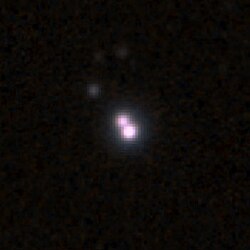
 2M1101A is on the lower right and 2M1101B is the object on the upper left. Credit: ESO VHS | |
| Observation data Epoch J2000 Equinox ICRS | |
|---|---|
| Constellation | Chamaeleon |
| Right ascension | 11h 01m 19.198s1 |
| Declination | −77° 32′ 38.76″1 |
| Astrometry | |
| A | |
| Proper motion (μ) | RA: −22.653±0.4351 mas/yr Dec.: +2.062±0.3971 mas/yr |
| Parallax (π) | 5.4081±0.1877 mas1 |
| Distance | 600 ± 20 ly (185 ± 6 pc) |
| Other designations | |
| 2MASS J11011926–7732383, WDS J11013-7733AB, LUH 1 | |
| Database references | |
| SIMBAD | data |
2MASS J11011926–7732383 AB (abbreviated 2M1101AB; LUH 1) is a brown dwarf binary about 600 light-years distant in the Chamaeleon. constellation. The wide binary pair is separated by about 240 astronomical units. The system was the first discovery of a brown dwarf binary with a separation greater than 20 au. The discovery gave fundamental insights into the formation of brown dwarfs.2 Previously it was thought that such wide binary brown dwarfs are not formed or at least are disrupted at ages of 1-10 Myrs. Together with other wide binaries, such as Oph 162225-240515 or UScoCTIO 108, the existence of this system was inconsistent with the ejection hypothesis, a proposed hypothesis in which brown dwarfs form in a multiple system, but are ejected before they gain enough mass to burn hydrogen.3 The ejection hypothesis predicted a maximum separation of 10 au for brown dwarf binaries.4
The system was discovered by Kevin Luhman in 2004 during observations of candidate young brown dwarfs in Chamaeleon I, using the Magellan I telescope.3
The primary 2M1101A has a spectral type of M7.25 ± 0.25, with a mass of about 52 MJ and a temperature of 2838 K (2565 °C; 4649 °F). The secondary 2M1101B has a spectral type of M8.25 ± 0.25, with a mass of about 26 MJ and a temperature of 2632 K (2359 °C; 4279 °F). Based on spectral features, such as sodium and potassium absorption lines it was concluded that both brown dwarfs are young and part of Chamaeleon I.3 The brown dwarfs in 2M1101AB belong to the youngest substellar members of Chamaeleon I with an approximate age of 1 million years.5 Measurements by ESA's Gaia satellite show a similar parallax and proper motion for both brown dwarfs.1 The system has a relatively low binding energy of ergs.2
The system was detected in x-rays with Chandra and XMM-Newton. While XMM-Newton could not resolve the binary it detected the primary. Chandra resolved the binary and detected the secondary in the system. These apparently contradictory results were interpreted as strong variability of the x-ray emissions by this system.5
References
References
- Brown, A. G. A.; et al. (Gaia collaboration) (August 2018). "Gaia Data Release 2: Summary of the contents and survey properties". Astronomy & Astrophysics. 616. A1. arXiv:1804.09365. Bibcode:2018A&A...616A...1G. doi:10.1051/0004-6361/201833051. Gaia DR2 record for this source at VizieR.
- Faherty, Jacqueline K.; Goodman, Sam; Caselden, Dan; Colin, Guillaume; Kuchner, Marc J.; Meisner, Aaron M.; Gagne', Jonathan; Schneider, Adam C.; Gonzales, Eileen C.; Gagliuffi, Daniella C. Bardalez; Logsdon, Sarah E. (2020). "WISE2150-7520AB: A very low mass, wide co-moving brown dwarf system discovered through the citizen science project Backyard Worlds: Planet 9". The Astrophysical Journal. 889 (2): 176. arXiv:1911.04600. Bibcode:2020ApJ...889..176F. doi:10.3847/1538-4357/ab5303. S2CID 207863267.
- Luhman, K. L. (October 2004). "The First Discovery of a Wide Binary Brown Dwarf". Astrophysical Journal. 614 (1): 398–403. arXiv:astro-ph/0407344. Bibcode:2004ApJ...614..398L. doi:10.1086/423666. ISSN 0004-637X. S2CID 11733526.
- Bate, Matthew R.; Bonnell, Ian A.; Bromm, Volker (May 2002). "The formation mechanism of brown dwarfs". MNRAS. 332 (3): L65–L68. arXiv:astro-ph/0206365. Bibcode:2002MNRAS.332L..65B. doi:10.1046/j.1365-8711.2002.05539.x. ISSN 0035-8711.
- Stelzer, B.; Micela, G. (October 2007). "X-ray detection of the substellar twin 2MASS J11011926-7732383 AB". Astronomy & Astrophysics. 474 (1): 129–136. arXiv:0706.2301. Bibcode:2007A&A...474..129S. doi:10.1051/0004-6361:20077564. ISSN 0004-6361.