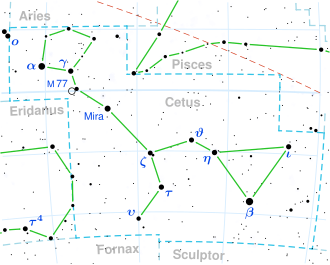
  | |
| Observation data Epoch J2000 Equinox J2000 | |
|---|---|
| Constellation | Cetus |
| Right ascension | 00h 03m 44.38784s1 |
| Declination | −17° 20′ 09.5719″1 |
| Apparent magnitude (V) | 4.4832 |
| Characteristics | |
| Evolutionary stage | main sequence34 |
| Spectral type | B9 IVn5 |
| U−B color index | −0.126 |
| B−V color index | −0.047±0.0037 |
| Astrometry | |
| Radial velocity (Rv) | +8.0±4.68 km/s |
| Proper motion (μ) | RA: +25.171 mas/yr Dec.: −9.161 mas/yr |
| Parallax (π) | 11.98±0.26 mas1 |
| Distance | 272 ± 6 ly (83 ± 2 pc) |
| Absolute magnitude (MV) | −0.067 |
| Details | |
| Mass | 2.589 M☉ |
| Radius | 3.929 R☉ |
| Luminosity | 119+6 −54 L☉ |
| Surface gravity (log g) | 3.669 cgs |
| Temperature | 11,419±38810 K |
| Metallicity [Fe/H] | +0.00±0.245 dex |
| Rotational velocity (v sin i) | 1164 or 23711 km/s |
| Age | 21710 Myr |
| Other designations | |
| Hydor, 2 Cet, BD−18°6417, FK5 905, HD 225132, HIP 301, HR 9098, SAO 14705912 | |
| Database references | |
| SIMBAD | data |
2 Ceti, also named Hydor,13 is a single14 star in the equatorial constellation of Cetus, near the border with Aquarius. It is visible to the naked eye with an apparent visual magnitude of 4.483.2 The distance to 2 Ceti can be estimated from its annual parallax shift of 12.0 mas,1 which yields a value of around 272 light years. It appears to be moving further from the Earth with a heliocentric radial velocity of about +8 km/s.8
The stellar classification for this star is B9 IVn,5 matching a B-type subgiant star with "nebulous" absorption lines due to rapid rotation.15 Estimates of the rotation rate range from 1164 to 23711 km/s, and this high rate of spin is giving the star an equatorial bulge that is 12% larger than the polar radius.15 2 Ceti is about 217 million years old10 with 2.6 times the mass of the Sun and 3.9 times the Sun's radius.9 It is radiating 119 times the Sun's luminosity4 from its photosphere at an effective temperature of 11,419 K.10 An infrared excess has been detected around this star by the Akari satellite at a wavelength of 18μm, suggesting there is an orbiting debris disk.16
Naming
The ancient Greek term Hydor (ὕδωρ), meaning water, originally referred to a constellation of faint stars in the region of Aquarius and Cetus.17 The IAU Working Group on Star Names approved the name Hydor for 2 Ceti, on 25 August 2025 and it is now so entered in the IAU Catalog of Star Names;13 it had previously been used for λ Aquarii, for which the IAU adopted the Indian name Shatabhisha.17
References
References
- van Leeuwen, F. (2007). "Validation of the new Hipparcos reduction". Astronomy and Astrophysics. 474 (2): 653–664. arXiv:0708.1752. Bibcode:2007A&A...474..653V. doi:10.1051/0004-6361:20078357. S2CID 18759600.
- Høg, E.; et al. (2000). "The Tycho-2 catalogue of the 2.5 million brightest stars". Astronomy and Astrophysics. 355: L27–L30. Bibcode:2000A&A...355L..27H.
- Vallenari, A.; et al. (Gaia collaboration) (2023). "Gaia Data Release 3. Summary of the content and survey properties". Astronomy and Astrophysics. 674: A1. arXiv:2208.00211. Bibcode:2023A&A...674A...1G. doi:10.1051/0004-6361/202243940. S2CID 244398875. Gaia DR3 record for this source at VizieR.
- Zorec, J.; et al. (2012). "Rotational velocities of A-type stars. IV. Evolution of rotational velocities". Astronomy and Astrophysics. 537: A120. arXiv:1201.2052. Bibcode:2012A&A...537A.120Z. doi:10.1051/0004-6361/201117691. S2CID 55586789.
- Wu, Yue; et al. (2010). "Coudé-feed stellar spectral library – atmospheric parameters". Astronomy & Astrophysics. 525: A71. arXiv:1009.1491. Bibcode:2011A&A...525A..71W. doi:10.1051/0004-6361/201015014. S2CID 53480665.
- Nicolet, B. (1964). "Catalogue of homogeneous data in the UBV photoelectric photometric system". Astronomy and Astrophysics Supplement Series. 34: 1–49. Bibcode:1978A&AS...34....1N.
- Anderson, E.; Francis, Ch. (2012), "XHIP: An extended hipparcos compilation", Astronomy Letters, 38 (5): 331, arXiv:1108.4971, Bibcode:2012AstL...38..331A, doi:10.1134/S1063773712050015, S2CID 119257644.
- Gontcharov, G. A. (2006). "Pulkovo Compilation of Radial Velocities for 35 495 Hipparcos stars in a common system". Astronomy Letters. 32 (11): 759–771. arXiv:1606.08053. Bibcode:2006AstL...32..759G. doi:10.1134/S1063773706110065. S2CID 119231169.
- Stassun, Keivan G.; et al. (2019). "The Revised TESS Input Catalog and Candidate Target List". The Astronomical Journal. 158 (4): 138. arXiv:1905.10694. Bibcode:2019AJ....158..138S. doi:10.3847/1538-3881/ab3467.
- David, Trevor J.; Hillenbrand, Lynne A. (2015). "The Ages of Early-Type Stars: Strömgren Photometric Methods Calibrated, Validated, Tested, and Applied to Hosts and Prospective Hosts of Directly Imaged Exoplanets". The Astrophysical Journal. 804 (2): 146. arXiv:1501.03154. Bibcode:2015ApJ...804..146D. doi:10.1088/0004-637X/804/2/146. S2CID 33401607.
- Royer, F.; et al. (2007). "Rotational velocities of A-type stars". Astronomy and Astrophysics. 463 (2): 671. arXiv:astro-ph/0610785. Bibcode:2007A&A...463..671R. doi:10.1051/0004-6361:20065224. S2CID 18475298.
- "2 Cet". SIMBAD. Centre de données astronomiques de Strasbourg. Retrieved December 23, 2018.
- "IAU Catalog of Star Names". Retrieved 26 August 2025.
- Chini, R.; et al. (2012). "A spectroscopic survey on the multiplicity of high-mass stars". Monthly Notices of the Royal Astronomical Society. 424 (3): 1925–1929. arXiv:1205.5238. Bibcode:2012MNRAS.424.1925C. doi:10.1111/j.1365-2966.2012.21317.x. S2CID 119120749.
- van Belle, Gerard T. (March 2012). "Interferometric observations of rapidly rotating stars". The Astronomy and Astrophysics Review. 20 (1): 51. arXiv:1204.2572. Bibcode:2012A&ARv..20...51V. doi:10.1007/s00159-012-0051-2. S2CID 119273474.
- Ishihara, Daisuke; et al. (May 2017). "Faint warm debris disks around nearby bright stars explored by AKARI and IRSF". Astronomy & Astrophysics. 601: 18. arXiv:1608.04480. Bibcode:2017A&A...601A..72I. doi:10.1051/0004-6361/201526215. S2CID 55234482. A72.
- "Hydor". All Skies Encyclopaedia. IAU Working Group on Star Names. Retrieved 26 August 2025.