  | |
| Observation data Epoch J2000.0 Equinox ICRS | |
|---|---|
| Constellation | Auriga |
| Right ascension | 04h 52m 37.98035s1 |
| Declination | +36° 42′ 11.4771″1 |
| Apparent magnitude (V) | +4.792 |
| Characteristics | |
| Evolutionary stage | red giant branch1 |
| Spectral type | K3- III Ba0.43 |
| Apparent magnitude (G) | 4.281 |
| B−V color index | 1.414±0.0034 |
| Astrometry | |
| Radial velocity (Rv) | −17.24±0.084 km/s |
| Proper motion (μ) | RA: −25.273±0.1251 mas/yr Dec.: −3.715±0.0981 mas/yr |
| Parallax (π) | 5.2978±0.1192 mas1 |
| Distance | 620 ± 10 ly (189 ± 4 pc) |
| Absolute magnitude (MV) | –1.842 |
| Details | |
| Mass | 2.865 M☉ |
| Radius | 48.14+0.83 −1.796 R☉ |
| Luminosity | 599±296 L☉ |
| Surface gravity (log g) | 1.797 cgs |
| Temperature | 4,115+79 −356 K |
| Metallicity [Fe/H] | −0.24±0.034 dex |
| Rotational velocity (v sin i) | 2.37 km/s |
| Age | 1.805 Gyr |
| Other designations | |
| 2 Aur, BD+36°952, FK5 1201, HD 30834, HIP 22678, HR 1551, SAO 57475, Gaia DR3 1982713970817465608 | |
| Database references | |
| SIMBAD | data |

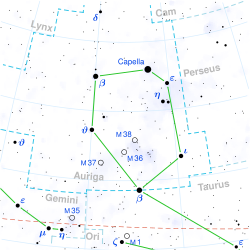
2 Aurigae is a possible binary star system in the northern constellation of Auriga. This object is visible to the naked eye as a faint, orange-hued star with an apparent visual magnitude of +4.79.2 It forms an attractive four-star asterism when viewed in a low power eyepiece, together with the nearby HIP 22647 and another very loose visual pair, HIP 22776 and HIP 22744, all above magnitude 8. 2 Aurigae is moving closer to the Earth with a heliocentric radial velocity of −17 km/s.4
The visible component is an aging giant star with a stellar classification of K3- III Ba0.4.3 The suffix notation indicates this is a mild barium star, which means the stellar atmosphere is enriched with s-process elements. It is either a member of a close binary system and has previously acquired these elements from a (now) white dwarf companion or else it is on the asymptotic giant branch and is generating the elements itself.9 2 Aurigae is 1.805 billion years old with 2.865 times the mass of the Sun and has expanded to 486 times the Sun's radius. It is radiating 5996 times the Sun's luminosity from its enlarged photosphere at an effective temperature of 4,115 K.6
References
References
- Vallenari, A.; et al. (Gaia collaboration) (2023). "Gaia Data Release 3. Summary of the content and survey properties". Astronomy and Astrophysics. 674: A1. arXiv:2208.00211. Bibcode:2023A&A...674A...1G. doi:10.1051/0004-6361/202243940. S2CID 244398875. Gaia DR3 record for this source at VizieR.
- Jasniewicz, G.; et al. (February 1999), "Late-type giants with infrared excess. I. Lithium abundances", Astronomy and Astrophysics, 342: 831–838, Bibcode:1999A&A...342..831J
- Keenan, Philip C.; McNeil, Raymond C. (1989), "The Perkins catalog of revised MK types for the cooler stars", Astrophysical Journal Supplement Series, 71: 245, Bibcode:1989ApJS...71..245K, doi:10.1086/191373, S2CID 123149047.
- Anderson, E.; Francis, Ch. (2012), "XHIP: An extended hipparcos compilation", Astronomy Letters, 38 (5): 331, arXiv:1108.4971, Bibcode:2012AstL...38..331A, doi:10.1134/S1063773712050015, S2CID 119257644.
- Luck, R. Earle (2015), "Abundances in the Local Region. I. G and K Giants", Astronomical Journal, 150 (3), 88, arXiv:1507.01466, Bibcode:2015AJ....150...88L, doi:10.1088/0004-6256/150/3/88, S2CID 118505114.
- Brown, A. G. A.; et al. (Gaia collaboration) (August 2018). "Gaia Data Release 2: Summary of the contents and survey properties". Astronomy & Astrophysics. 616. A1. arXiv:1804.09365. Bibcode:2018A&A...616A...1G. doi:10.1051/0004-6361/201833051. Gaia DR2 record for this source at VizieR.
- Takeda, Y.; Tajitsu, A. (August 2017), "On the observational characteristics of lithium-enhanced giant stars in comparison with normal red giants", Publications of the Astronomical Society of Japan, 69 (4): 978–88, arXiv:1706.02273, Bibcode:2017PASJ...69...74T, doi:10.1093/pasj/psx057.
- "2 Aur". SIMBAD. Centre de données astronomiques de Strasbourg. Retrieved 2019-04-03.
- Gomez, A. E.; et al. (1997), "Absolute magnitudes and kinematics of barium stars", Astronomy and Astrophysics, 319: 881, Bibcode:1997A&A...319..881G.