 | |
 | |
| Names | |
|---|---|
| Preferred IUPAC name
1-Chloro-2,4-dinitrobenzene | |
| Other names
Dinitrochlorobenzene
Chlorodinitrobenzene 2,4-Dinitrochlorobenzene 2,4-Dinitrophenyl chloride 4-Chloro-1,3-dinitrobenzene | |
| Identifiers | |
| |
3D model (JSmol)
|
|
| Abbreviations | CDNB; DNCB |
| ChEBI | |
| ChemSpider |
|
| ECHA InfoCard | 100.002.321 |
| EC Number |
|
PubChem CID
|
|
| UNII | |
CompTox Dashboard (EPA)
|
|
| |
| |
| Properties | |
| C6H3ClN2O4 | |
| Molar mass | 202.55 g·mol−1 |
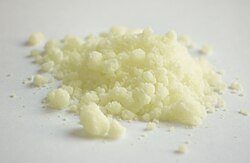
| Appearance | yellow crystals |
| Odor | almond-like |
| Density | 1.6867 g/cm3 |
| Melting point | 54 °C (129 °F; 327 K) |
| Boiling point | 315 °C (599 °F; 588 K) |
| Insoluble1 | |
| Solubility | soluble in ether, benzene, CS2 |
Refractive index (nD)
|
1.5857 (60 °C) |
| Hazards | |
| NFPA 704 (fire diamond) | |
| Explosive limits | 2–22% |
| Lethal dose or concentration (LD, LC): | |
LD50 (median dose)
|
1.07 g/kg (rat, oral) |
Except where otherwise noted, data are given for materials in their standard state (at 25 °C [77 °F], 100 kPa).
| |



2,4-Dinitrochlorobenzene (DNCB) is an organic compound with the chemical formula (O2N)2C6H3Cl. It is a yellow solid that is soluble in organic solvents. It is an intermediate for the industrial production of other compounds.2
Preparation and reactions
DNCB is produced commercially by the nitration of p-nitrochlorobenzene with a mixture of nitric and sulfuric acids. Other methods afford the compound less efficiently include the chlorination of 1,3-dinitrobenzene, nitration of o-nitrochlorobenzene and the dinitration of chlorobenzene.3
By virtue of the two nitro substituents, the chloride in DNCB is particularly susceptible to nucleophilic substitution, at least relative to simple chlorobenzene. In this way, the compound is a precursor to many other compounds. For example, the chloride can be replaced by iodide easily.456
Reaction of DNCB with ammonia gives 2,4-dinitrochloroaniline, again a versatile precursor.2
DNCB is as a substrate in glutathione S-transferase, relevant to activity assays.7
Safety
DNCB induces a type IV hypersensitivity reaction in almost all people exposed to it, so it is used medically to assess the T cell activity in patients. This is a useful diagnostic test for immunocompromised patients. It can also be used to treat warts.8
DNCB can cause contact dermatitis.9
References
References
- "1-Chloro-2,4-dinitrobenzene". Sigma-Aldrich. Retrieved 8 September 2014.
- Gerald Booth (2007). "Nitro Compounds, Aromatic". Ullmann's Encyclopedia of Industrial Chemistry. Weinheim: Wiley-VCH. doi:10.1002/14356007.a17_411. ISBN 978-3527306732.
- "Synthesis of 1-chloro-2,4-dinitrobenzene - F. Ullmann, Verlag S. Hirzel Leipzig, 1908" (PDF). Retrieved 19 May 2020.
- J. F. Bunnett, R. M. Conner (1960). "2,4-Dinitroiodobenzene". Organic Syntheses. 40: 34. doi:10.15227/orgsyn.040.0034.
- F. B. Wells, C. F. H. Allen (1935). "2,4-Dinitroaniline". Organic Syntheses. 15: 22. doi:10.15227/orgsyn.015.0022.
- Norman Kharasch, Robert B. Langford (1964). "2,4-Dinitrobenzenesulfenyl Chloride". Organic Syntheses. 44: 47. doi:10.15227/orgsyn.044.0047.
- Habig WH, Pabst MJ, Jakoby WB (1974). "Glutathione S-transferases. The first enzymatic step in mercapturic acid formation". J Biol Chem. 249 (22): 7130–7139. doi:10.1016/S0021-9258(19)42083-8. PMID 4436300.
- "Treating warts". Harvard Medical School. Archived from the original on 2010-11-03. Retrieved April 2, 2010.
- White SI, Friedmann PS, Moss C, Simpson JM (1986). "The effect of altering area of application and dose per unit area on sensitization by DNCB". Br. J. Dermatol. 115 (6): 663–8. doi:10.1111/j.1365-2133.1986.tb06646.x. PMID 3801307. S2CID 21476276.