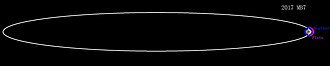
 Highly eccentric orbit of 2017 MB7 | |
| Discovery1 | |
|---|---|
| Discovered by | Pan-STARRS 1 |
| Discovery site | Haleakala Obs. |
| Discovery date | 22 June 2017 (first observed only) |
| Designations | |
| TNO2 · damocloid3 unusual4 · distant1 | |
| Orbital characteristics2 | |
| Epoch 31 May 2020 (JD 2459000.5) | |
| Uncertainty parameter 2 | |
| Observation arc | 174 days |
| Aphelion | 3,419±89 AU |
| Perihelion | 4.458 AU |
| 1,712±45 AU | |
| Eccentricity | 0.9974 |
| 70,825±2,767 yr | |
| 0.0181° | |
| 0° 0m 0.05s / day | |
| Inclination | 55.724° |
| 58.247° | |
| 80.627±0.002° | |
| TJupiter | 1.477 |
| Physical characteristics | |
| 9 km (assumed)3 | |
| 0.09 (assumed)3 | |
| 14.156±0.3322 14.21 | |
2017 MB7 is a trans-Neptunian object and damocloid on a cometary-like orbit from the outer Solar System, approximately 9 kilometers (6 miles) in diameter. It was first observed on 22 June 2017 by the Pan-STARRS survey at Haleakala Observatory in Hawaii, United States.1 This unusual object has the largest heliocentric aphelion, semi-major axis, orbital eccentricity and orbital period of any known periodic minor planet, even larger than that of 2010 LN135 and 2014 FE72; it is calculated to reach several thousand AU (Earth–Sun) distances at the farthest extent of its orbit.
Orbit and classification
2017 MB7 orbits the Sun at a distance of 4.5–3,419 AU once every 70,825 years (semi-major axis of 1712 AU). Its orbit has an eccentricity of 0.9974 and an inclination of 56° with respect to the ecliptic.2
As it has an eccentricity higher than 0.50, the distant object is labelled an (other) unusual object by the Minor Planet Center.4 Johnston's Archive groups it to the damocloids,3 due to its extreme orbital elements and a TJupiter of less than 2, while in JPL's Small Body Database, it is a trans-Neptunian object with a semi-major axis larger than that of Neptune.2
Physical characteristics
Very little is known for certain about the body's physical characteristics. Johnston's Archive assumes a generic distant-object albedo of 0.09 and calculates a diameter of 9 kilometers.3 Like other distant objects, it is probably also fairly red in appearance due to tholins on its surface.
References
References
- "2017 MB7". Minor Planet Center. Retrieved 19 November 2018.
- "JPL Small-Body Database Browser: (2017 MB7)" (2017-12-13 last obs.). Jet Propulsion Laboratory. Retrieved 14 February 2021.
- Johnston, Wm. Robert (7 October 2018). "List of Known Trans-Neptunian Objects". Johnston's Archive. Retrieved 19 November 2018.
- "List Of Other Unusual Objects". Minor Planet Center. 14 November 2018. Retrieved 19 November 2018.
External links
External links
- 2017 MB7 at AstDyS-2, Asteroids—Dynamic Site
- 2017 MB7 at the JPL Small-Body Database