| Discovery | |
|---|---|
| Discovered by | Alianza S4 |
| Discovery site | Cerro Burek |
| Discovery date | 21 September 2011 |
| Designations | |
Martian L5 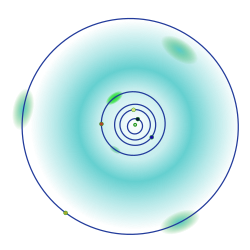 | |
| Orbital characteristics1 | |
| Epoch 13 January 2016 (JD 2457400.5) | |
| Uncertainty parameter 2 | |
| Observation arc | 1637 days (4.48 yr) |
| Aphelion | 1.698231 AU (254.0517 Gm) |
| Perihelion | 1.349540 AU (201.8883 Gm) |
| 1.523885 AU (227.9700 Gm) | |
| Eccentricity | 0.114409 |
| 1.88 yr (687.11 d) | |
| 55.63918° | |
| 0° 31m 26.159s /day | |
| Inclination | 21.49603° |
| 9.413048° | |
| 53.31859° | |
| Earth MOID | 0.396438 AU (59.3063 Gm) |
| Jupiter MOID | 3.52931 AU (527.977 Gm) |
| Physical characteristics | |
| 550±230 m | |
| 0.5-0.05 (assumed) | |
| 19.4 | |
2011 SL25 is an asteroid and Mars trojan candidate that shares the orbit of the planet Mars at its L5 point.2
Discovery, orbit and physical properties
2011 SL25 was discovered on 21 September 2011 at the Alianza S4 Observatory (I08) on Cerro Burek in Argentina3 and classified as Mars-crosser by the Minor Planet Center. It follows a relatively eccentric orbit (0.11) with a semi-major axis of 1.52 AU.3 This object has noticeable orbital inclination (21.5°).3 Its orbit was initially poorly constrained, with only 76 observations over 42 days, but was recovered in January 2014.1 2011 SL25 has an absolute magnitude of 19.5 which gives a characteristic diameter of 575 m.1
Mars trojan and orbital evolution
Recent calculations indicate that it is a stable L5 Mars Trojan with a libration period of 1400 yr and an amplitude of 18°.24 values as well as its short-term orbital evolution are similar to those of 5261 Eureka.56
Origin
Long-term numerical integrations show that its orbit is stable on Gyr time-scales (1 Gyr = 1 billion years). It appears to be stable at least for 4.5 Gyr but its current orbit indicates that it has not been a dynamical companion to Mars for the entire history of the Solar System.2
See also
See also
References
References
- "JPL Small-Body Database Browser: (2011 SL25)". Jet Propulsion Laboratory. Retrieved 31 March 2016.
- de la Fuente Marcos, C.; de la Fuente Marcos, R. (April 2013). "Three new stable L5 Mars Trojans". Monthly Notices of the Royal Astronomical Society: Letters. 432 (1): L31–L35. arXiv:1303.0124. Bibcode:2013MNRAS.432L..31D. doi:10.1093/mnrasl/slt028. S2CID 118693165.
- MPC data on 2011 SL25
- Christou, A. A. (2013). "Orbital clustering of Martian Trojans: An asteroid family in the inner solar system?". Icarus. 224 (1): 144–153. arXiv:1303.0420. Bibcode:2013Icar..224..144C. doi:10.1016/j.icarus.2013.02.013. S2CID 119186791.
- Christou, Apostolos A.; Borisov, Galin; Dell'Oro, Aldo; Cellino, Alberto; Devogèle, Maxime (January 2021). "Composition and origin of L5 Trojan asteroids of Mars: Insights from spectroscopy". Icarus. 354 (1): 113994 (22 pages). arXiv:2010.10947. Bibcode:2021Icar..35413994C. doi:10.1016/j.icarus.2020.113994. S2CID 224814529.
- de la Fuente Marcos, Carlos; de la Fuente Marcos, Raúl (March 2021). "Using Mars co-orbitals to estimate the importance of rotation-induced YORP break-up events in Earth co-orbital space". Monthly Notices of the Royal Astronomical Society. 501 (4): 6007–6025. arXiv:2101.02563. Bibcode:2021MNRAS.501.6007D. doi:10.1093/mnras/stab062. ISSN 0035-8711.
- Further reading
- Three new stable L5 Mars Trojans de la Fuente Marcos, C., de la Fuente Marcos, R. 2013, Monthly Notices of the Royal Astronomical Society: Letters, Vol. 432, Issue 1, pp. 31–35.
- Orbital clustering of Martian Trojans: An asteroid family in the inner solar system? Christou, A. A. 2013, Icarus, Vol. 224, Issue 1, pp. 144–153.
External links
External links
- 2011 SL25 data at MPC.
- 2011 SL25 at AstDyS-2, Asteroids—Dynamic Site
- 2011 SL25 at ESA–space situational awareness
- 2011 SL25 at the JPL Small-Body Database