| Discovery12 | |
|---|---|
| Discovered by | Mount Lemmon Srvy. |
| Discovery site | Mount Lemmon Obs. (first observed only) |
| Discovery date | 1 November 2005 |
| Designations | |
| TNO3 · damocloid4 unusual5 · distant1 | |
| Orbital characteristics3 | |
| Epoch 21 November 2025 (JD 2461000.5) | |
| Uncertainty parameter 4 | |
| Observation arc | 81 days |
| Aphelion | 2124.24 AU |
| Perihelion | 4.1435 AU |
| 1064.19 AU | |
| Eccentricity | 0.9961 |
| 34,717 yr | |
| 0.2061° | |
| 0° 0m 0.101s / day | |
| Inclination | 112.69° |
| 255.11° | |
| 196.48° | |
| Jupiter MOID | 0.8405 AU |
| TJupiter | −0.968 |
| Physical characteristics | |
| 7 km (est.)4 | |
| 0.09 (assumed)4 | |
| 14.113 | |
2005 VX3 is a trans-Neptunian object and retrograde damocloid on a highly eccentric, cometary-like orbit. It was first observed on 1 November 2005, by astronomers with the Mount Lemmon Survey at the Mount Lemmon Observatory in Arizona, United States. The unusual object measures approximately 7 kilometers (4 miles) in diameter.4 It has the 3rd largest known heliocentric semi-major axis and aphelion.6 Additionally its perihelion lies within the orbit of Jupiter, which means it also has the largest orbital eccentricity of any known minor planet.
Description
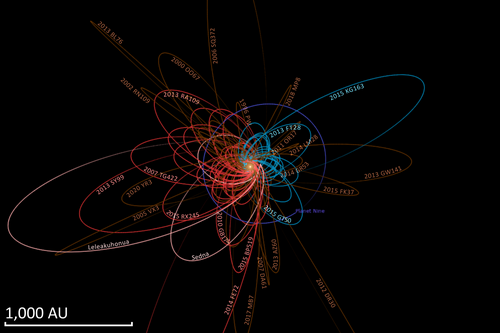
2005 VX3 orbits the Sun at a distance of 4.1–2,124 AU once every 34,717 years (semi-major axis of 1,064 AU). Its orbit has an eccentricity of 0.9961 and an inclination of 113° with respect to the ecliptic. It belongs to the dynamical group of damocloids due to its retrograde orbit and its low Tisserand parameter (TJupiter of −0.968).3 It is a Jupiter-, Saturn-, Uranus-, and Neptune-crosser. The body's observation arc begins with its first observation by the Mount Lemmon Survey on 1 November 2005.1
| Orbital evolution — Barycentric elements | |||
| Year7 (epoch) |
Aphelion | Semi-major axis | Ref |
|---|---|---|---|
| 1950 | 2710 AU | n.a. | a |
| 2012 | 1914 AU | n.a. | b |
| 2015 | 2563 AU | n.a. | c |
| 2016 | 3235 AU | n.a. | d |
| 2050 | 2049 AU | 1026 AU | a |
2005 VX3 has a barycentric semi-major axis of ~1026 AU.7a 2014 FE72 and (668643) 2012 DR30 have a larger barycentric semi-major axis. The epoch of January 2016 was when 2005 VX3 had its largest heliocentric semi-major axis.
The object has a short observation arc of 81 days and does not have a well constrained orbit.3 It has not been observed since January 2006, when it came to perihelion, 4.1 AU from the Sun.3 It may be a dormant comet that has not been seen outgassing. In the past it may have made closer approaches to the Sun that could have removed most near-surface volatiles. The current orbit crosses the ecliptic just inside Jupiter's orbit and has a Jupiter-MOID of 0.8 AU.3
In 2017, it had an apparent magnitude of ~28 and was 24 AU from the Sun. It comes to opposition in mid-June. It would require one of the largest telescopes in the world for any more follow-up observations.
Comparison
See also
See also
Notes
Notes
References
References
- "2005 VX3". Minor Planet Center. Retrieved 20 November 2018.
- "MPEC 2005-V58 : 2005 VX3". IAU Minor Planet Center. 8 November 2005. Retrieved 20 November 2018. (K05V03X)
- "JPL Small-Body Database Browser: (2005 VX3)" (2006-01-21 last obs.). Jet Propulsion Laboratory. Retrieved 20 November 2018.
- Johnston, Wm. Robert (7 October 2018). "List of Known Trans-Neptunian Objects". Johnston's Archive. Retrieved 19 November 2018.
- "List Of Other Unusual Objects". Minor Planet Center. 14 November 2018. Retrieved 19 November 2018.
- "JPL Small-Body Database Search Engine: Asteroids and a > 100 (AU)". JPL Solar System Dynamics. Retrieved 6 March 2014. (Epoch defined at will change every 6 months or so)
- Horizons output. "Barycentric Osculating Orbital Elements for 2005 VX3". Retrieved 6 March 2014. (Solution using the Solar System Barycenter and barycentric coordinates. Select Ephemeris Type:Elements and Center:@0)
- Kaib, Nathan A.; Becker, Andrew C.; Jones, R. Lynne; Puckett, Andrew W.; Bizyaev, Dmitry; Dilday, Benjamin; et al. (April 2009). "2006 SQ372: A Likely Long-Period Comet from the Inner Oort Cloud". The Astrophysical Journal. 695 (1): 268–275. arXiv:0901.1690. Bibcode:2009ApJ...695..268K. doi:10.1088/0004-637X/695/1/268. S2CID 16987581.