 | |
| Discovery1 | |
|---|---|
| Discovered by | LONEOS |
| Discovery date | 30 April 2005 |
| Designations | |
| Orbital characteristics2 | |
| Epoch 3 May 2005 (JD 2453493.5) | |
| Uncertainty parameter 9 | |
| Aphelion | 3.5707 AU (534.17 Gm) |
| Perihelion | 0.070657 AU (10.5701 Gm) |
| 1.8207 AU (272.37 Gm) | |
| Eccentricity | 0.96119 |
| 2.46 yr (897.30 d) | |
| 341.42° | |
| 0° 24m 4.32s /day | |
| Inclination | 8.3967° |
| 63.790° | |
| 309.01° | |
| Earth MOID | 0.0615074 AU (9.20138 Gm) |
| Jupiter MOID | 1.92798 AU (288.422 Gm) |
| Physical characteristics | |
| Dimensions | 210–480 m3 |
| 20.7 | |
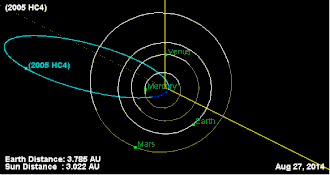
2005 HC4 is the asteroid with the second-smallest perihelion and the asteroid with the smallest known perihelion of any known object orbiting the Sun from 2005 to 2024 (except sungrazing comets). Its extreme orbital eccentricity brings it to within 0.071 AU of the Sun (23% of Mercury's perihelion) and takes it as far as 3.562 AU from the Sun (well beyond the orbit of Mars).4 Since then, another asteroid, 2024 YL3, has been found to have a closer perihelion, at about 0.070 AU.5 Due to its very small perihelion and comparably large aphelion, 2005 HC4 achieves the fastest speed of any known asteroid bound to the Solar System with a velocity of 157 km/s (565,000 km/h; 351,000 mi/h) at perihelion6 (there are comets, however, which obtain much higher speeds).
See also
See also
References
References
- "MPEC 2005-J02 : 2005 HC4". IAU Minor Planet Center. 1 May 2005. Retrieved 5 March 2014. (K05H04C)
- "JPL Small-Body Database Browser: (2005 HC4)" (2005-05-11 last obs (arc=11 days)). Jet Propulsion Laboratory. Retrieved 30 March 2016.
- "NEODyS 2005 HC4". Near Earth Objects – Dynamic Site. Retrieved 7 March 2014.
- "IAU Minor Planet Center". minorplanetcenter.net. Retrieved 12 January 2026.
- "IAU Minor Planet Center". minorplanetcenter.net. Retrieved 12 January 2026.
- As calculated with the vis-viva-equation :
where:
- v is the relative speed of the two bodies
- r is the distance between the two bodies
- a is the semi-major axis (a > 0 for ellipses, a = ∞ or 1/a = 0 for parabolas, and a < 0 for hyperbolas)
- G is the gravitational constant
- M is the mass of the central body
External links
External links
- 2005 HC4 at NeoDyS-2, Near Earth Objects—Dynamic Site
- 2005 HC4 at ESA–space situational awareness
- 2005 HC4 at the JPL Small-Body Database