| |||
| Names | |||
|---|---|---|---|
| Preferred IUPAC name
1,2-Dithiolane | |||
| Identifiers | |||
| |||
3D model (JSmol)
|
|||
| 102454 | |||
| ChEBI | |||
| ChemSpider | |||
| 1029938 | |||
PubChem CID
|
|||
| UNII | |||
CompTox Dashboard (EPA)
|
|||
| |||
| |||
| Properties | |||
| C3H6S2 | |||
| Molar mass | 106.20 g·mol−1 | ||
| Related compounds | |||
Related compounds
|
Ethane-1,2-dithiol | ||
Except where otherwise noted, data are given for materials in their standard state (at 25 °C [77 °F], 100 kPa).
| |||

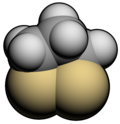


1,2-Dithiolane is an organosulfur compound with the formula S2(CH2)3. It is also classified as a heterocycle derived from cyclopentane by replacing two methylene bridges (−CH2− units) with a disulfide group. 1,3-Dithiolane is an isomer. The parent molecule is unimportant but substituted derivatives, especially lipoic acid and its derivatives, are often essential for life. Several occur naturally.1
The parent 1,2-dithiolane is the disulfide derived from 1,3-propanedithiol. It is however unstable with respect to oligomerization.2 In general, 1,3-dithiols are superior reductants relative to monothiols.3
Natural occurrence
Many substituted 1,2-dithiolates are found in nature.4 The most common is lipoic acid, a chiral dithiolane, which features a pentanoic acid substituent. It is essential for aerobic metabolism in mammals.
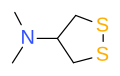
Some 1,2-dithiolane are found in some foods, such as asparagusic acid in asparagus.5 The 4-dimethylamino derivative nereistoxin was the inspiration for insecticides that act by blocking the nicotinic acetylcholine receptor.6
Several alkyl-substituted 1,2-dithiolanes occur in the scent glands of skunks and related mammals. These include 3,3-dimethyl-, 3-propyl-, 3-ethyl-1,2-dithiolane, and others.4


![Gerrardine, found in Cassipourea guianensis[4]](/api/ext/img?url=https%3A%2F%2Fupload.wikimedia.org%2Fwikipedia%2Fcommons%2Fthumb%2Fb%2Fb6%2FGerrardine.svg%2F120px-Gerrardine.svg.png)
![Charatoxin, found in chara globuluris[4]](/api/ext/img?url=https%3A%2F%2Fupload.wikimedia.org%2Fwikipedia%2Fcommons%2Fthumb%2Fb%2Fb7%2FCharatoxin.svg%2F120px-Charatoxin.svg.png)
Dithiolane-S-oxides

Many 1,2-dithiolanes can be oxidized to their S-oxides, which are chiral.4
References
References
- Teuber, Lene (1990). "Naturally Occurring 1,2-Dithiolanes and 1,2,3-Trithianes. Chemical and Biological Properties". Sulfur Reports. 9 (4): 257–333. doi:10.1080/01961779008048732.
- Goodrow, Marvin H.; Olmstead, Marilyn M.; Musker, W. Kenneth (1983). "Preparation and X-Ray Crystal Structure of the Cyclic Dimer of 1,2-Dithiolane: 1,2,6,7-Tetrathiacyclodecane". Phosphorus and Sulfur and the Related Elements. 16 (3): 299–302. doi:10.1080/03086648308080483.
- Burns, John A.; Whitesides, George M. (1990). "Predicting the stability of cyclic disulfides by molecular modeling: Effective concentrations in thiol-disulfide interchange and the design of strongly reducing dithiols". Journal of the American Chemical Society. 112 (17): 6296–6303. doi:10.1021/ja00173a017.
- Teuber, Lene (1990). "Naturally Occurring 1,2-Dithiolanes and 1,2,3-Trithianes. Chemical and Biological Properties". Sulfur Reports. 9 (4): 257–333. doi:10.1080/01961779008048732.
- Pelchat, M. L.; Bykowski, C.; Duke, F. F.; Reed, D. R. (2011). "Excretion and perception of a characteristic odor in urine after asparagus ingestion: A psychophysical and genetic study". Chemical Senses. 36 (1): 9–17. doi:10.1093/chemse/bjq081. PMC 3002398. PMID 20876394.
- Casida, John E.; Durkin, Kathleen A. (2013). "Neuroactive Insecticides: Targets, Selectivity, Resistance, and Secondary Effects". Annual Review of Entomology. 58: 99–117. doi:10.1146/annurev-ento-120811-153645. PMID 23317040.