  | |
| Observation data Epoch J2000 Equinox ICRS | |
|---|---|
| Constellation | Perseus |
| Right ascension | 02h 50m 35.05979s1 |
| Declination | 38° 19′ 07.1080″1 |
| Apparent magnitude (V) | 4.222 |
| Characteristics | |
| Spectral type | F2III3 |
| U−B color index | +0.084 |
| B−V color index | +0.344 |
| Variable type | δ Sct(?)56 |
| Astrometry | |
| Radial velocity (Rv) | +14.007 km/s |
| Proper motion (μ) | RA: +195.771 mas/yr Dec.: −109.981 mas/yr |
| Parallax (π) | 27.01±0.19 mas1 |
| Distance | 120.8 ± 0.8 ly (37.0 ± 0.3 pc) |
| Absolute magnitude (MV) | 1.382 |
| Details | |
| Mass | 1.808 M☉ |
| Radius | 3.29 R☉ |
| Luminosity | 23.362 L☉ |
| Surface gravity (log g) | 3.7210 cgs |
| Temperature | 7,00410 K |
| Metallicity [Fe/H] | −0.042 dex |
| Rotational velocity (v sin i) | 1493 km/s |
| Age | 1.448 Gyr |
| Other designations | |
| 16 Per, NSV 956, BD+37°646, FK5 2194, GC 3401, HD 17584, HIP 13254, HR 840, SAO 55928, CCDM J02506+3818A, LTT 1092411 | |
| Database references | |
| SIMBAD | data |
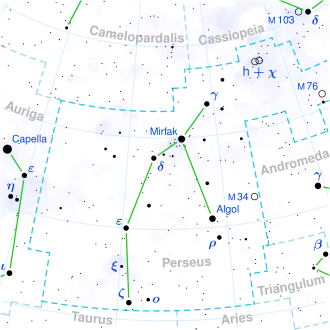
16 Persei is a single,12 suspected variable star6 in the northern constellation of Perseus, located approximately 121 light years away based on parallax.1 It is visible to the naked eye as a yellow-white hued star with an apparent visual magnitude of 4.22.2 This object is moving further from the Earth with a heliocentric radial velocity of +14 km/s.7 It displays a relatively high proper motion, traversing the celestial sphere at the rate of 0.224″ per year.13
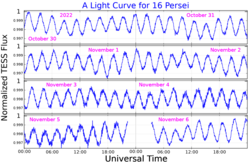
Based upon a stellar classification of F2 III,3 this matches an aging giant star that has exhausted the hydrogen at its core and is evolving away from the main sequence. It is a possible pulsating Delta Scuti variable, although there is some uncertainty about this classification.6 However, Kunzli and North (1998) found no variation.15 The star is 1.448 billion years old with 1.88 times the mass of the Sun and 3.29 times the Sun's radius. It shows a high rotation rate with a projected rotational velocity of 149 km/s,3 which is causing an equatorial bulge that is an estimated 24% larger than the polar radius.16 16 Persei is radiating 232 times the Sun's luminosity from its photosphere at an effective temperature of 7,004 K.10
It has two reported visual companions: B, with a magnitude of 12.8 and separation of 76.7", and C, with magnitude 10.43 and separation 234".17
References
References
- Van Leeuwen, F. (2007). "Validation of the new Hipparcos reduction". Astronomy and Astrophysics. 474 (2): 653–664. arXiv:0708.1752. Bibcode:2007A&A...474..653V. doi:10.1051/0004-6361:20078357. S2CID 18759600. Vizier catalog entry
- Anderson, E.; Francis, Ch. (2012). "XHIP: An extended hipparcos compilation". Astronomy Letters. 38 (5): 331. arXiv:1108.4971. Bibcode:2012AstL...38..331A. doi:10.1134/S1063773712050015. S2CID 119257644. Vizier catalog entry
- Hoffleit, D.; Warren, W. H. (1995). "VizieR Online Data Catalog: Bright Star Catalogue, 5th Revised Ed. (Hoffleit+, 1991)". VizieR On-line Data Catalog: V/50. Originally Published in: 1964BS....C......0H. 5050. Bibcode:1995yCat.5050....0H.
- Mallama, A. (2014). "Sloan Magnitudes for the Brightest Stars". The Journal of the American Association of Variable Star Observers. 42 (2): 443. Bibcode:2014JAVSO..42..443M.Vizier catalog entry
- "NSV 956". The International Variable Star Index. AAVSO – American Association of Variable Star Observers. Retrieved 17 February 2019.
- Samus, N. N.; et al. (2017). "General Catalogue of Variable Stars". Astronomy Reports. 5.1. 61 (1): 80–88. Bibcode:2017ARep...61...80S. doi:10.1134/S1063772917010085. S2CID 125853869.
- Wilson, R. E. (1953). "General Catalogue of Stellar Radial Velocities". Carnegie Institute Washington D.C. Publication. Carnegie Institution for Science. Bibcode:1953GCRV..C......0W. LCCN 54001336.
- Luck, R. Earle (2015), "Abundances in the Local Region. I. G and K Giants", Astronomical Journal, 150 (3), 88, arXiv:1507.01466, Bibcode:2015AJ....150...88L, doi:10.1088/0004-6256/150/3/88, S2CID 118505114.
- Allende Prieto, C.; Lambert, D. L. (1999). "Fundamental parameters of nearby stars from the comparison with evolutionary calculations: Masses, radii and effective temperatures". Astronomy and Astrophysics. 352: 555–562. arXiv:astro-ph/9911002. Bibcode:1999A&A...352..555A. Vizier catalog entry
- David, Trevor J.; Hillenbrand, Lynne A. (2015). "The Ages of Early-Type Stars: Strömgren Photometric Methods Calibrated, Validated, Tested, and Applied to Hosts and Prospective Hosts of Directly Imaged Exoplanets". The Astrophysical Journal. 804 (2): 146. arXiv:1501.03154. Bibcode:2015ApJ...804..146D. doi:10.1088/0004-637X/804/2/146. S2CID 33401607. Vizier catalog entry
- "16 Per". SIMBAD. Centre de données astronomiques de Strasbourg. Retrieved 2019-04-01.
- Eggleton, P. P.; Tokovinin, A. A. (September 2008). "A catalogue of multiplicity among bright stellar systems". Monthly Notices of the Royal Astronomical Society. 389 (2): 869–879. arXiv:0806.2878. Bibcode:2008MNRAS.389..869E. doi:10.1111/j.1365-2966.2008.13596.x. S2CID 14878976.
- Lépine, Sébastien; Shara, Michael M. (March 2005), "A Catalog of Northern Stars with Annual Proper Motions Larger than 0.15" (LSPM-NORTH Catalog)", The Astronomical Journal, 129 (3): 1483–1522, arXiv:astro-ph/0412070, Bibcode:2005AJ....129.1483L, doi:10.1086/427854, S2CID 2603568.
- "MAST: Barbara A. Mikulski Archive for Space Telescopes". Space Telescope Science Institute. Retrieved 24 May 2023.
- Kunzli, M.; North, P. (January 1998). "Are metallic A-F giants evolved AM stars? Rotation and rate of binaries among giant F stars". Astronomy and Astrophysics Supplement. 127 (2): 277–294. arXiv:astro-ph/9710226. Bibcode:1998A&AS..127..277K. doi:10.1051/aas:1998350. S2CID 7535170.
- van Belle, Gerard T. (March 2012), "Interferometric observations of rapidly rotating stars", The Astronomy and Astrophysics Review, 20 (1): 51, arXiv:1204.2572, Bibcode:2012A&ARv..20...51V, doi:10.1007/s00159-012-0051-2, S2CID 119273474.
- Mason, Brian D.; Wycoff, Gary L.; Hartkopf, William I.; Douglass, Geoffrey G.; Worley, Charles E. (2001). "The 2001 US Naval Observatory Double Star CD-ROM. I. The Washington Double Star Catalog". The Astronomical Journal. 122 (6): 3466. Bibcode:2001AJ....122.3466M. doi:10.1086/323920. Vizier catalog entry