  | |
| Observation data Epoch J2000.0 Equinox ICRS | |
|---|---|
| Constellation | Perseus1 |
| Right ascension | 02h 42m 14.91569s2 |
| Declination | +40° 11′ 38.1898″2 |
| Apparent magnitude (V) | 4.943 |
| Characteristics | |
| Evolutionary stage | main sequence4 |
| Spectral type | F9 V5 |
| U−B color index | +0.083 |
| B−V color index | +0.563 |
| Astrometry | |
| Radial velocity (Rv) | −23.04±0.046 km/s |
| Proper motion (μ) | RA: −17.202 mas/yr Dec.: −183.302 mas/yr |
| Parallax (π) | 41.34±0.43 mas2 |
| Distance | 78.9 ± 0.8 ly (24.2 ± 0.3 pc) |
| Absolute magnitude (MV) | +2.991 |
| Orbit | |
| Period (P) | 330.984 d |
| Semi-major axis (a) | 53.187 mas |
| Eccentricity (e) | 0.6634 |
| Inclination (i) | 127.177° |
| Details | |
| 12 Per A | |
| Mass | 1.382±0.0194 M☉ |
| Radius | 1.554 R☉ |
| Luminosity | 3.024 L☉ |
| Surface gravity (log g) | 4.20±0.104 cgs |
| Temperature | 6195±2004 K |
| Metallicity [Fe/H] | ≥0.354 dex |
| Rotational velocity (v sin i) | 138 km/s |
| Age | 1.124 Gyr |
| 12 Per B | |
| Mass | 1.240±0.0174 M☉ |
| Radius | 1.314 R☉ |
| Luminosity | 1.864 L☉ |
| Surface gravity (log g) | 4.30±0.104 cgs |
| Temperature | 6000±2004 K |
| Other designations | |
| 12 Per, BD+39° 610, FK5 2187, GJ 105.6 АВ, HD 16739, HIP 12623, HR 788, SAO 557939 | |
| Database references | |
| SIMBAD | data |
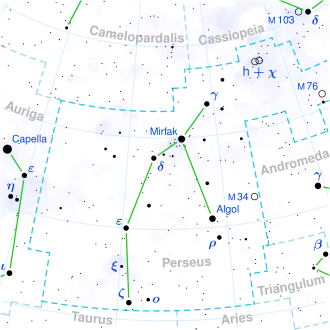
12 Persei (12 Per) is a double-lined spectroscopic binary star system in the northern constellation Perseus. Its combined apparent magnitude is 4.94,3 which means it can be viewed with the naked eye. Based upon parallax measurements, this system is about 79 light years away from the Sun.2
The magnitude difference between the two components is estimated to be 0.51. Based upon this, the primary has a mass around 138% of the Sun, 155% of the Sun's radius, and shines with three times the Sun's luminosity. The smaller secondary component is also larger than the Sun, with 124% of the Sun's mass, 131% of the radius of the Sun, and has 186% of the Sun's luminosity.4 The stellar classification of the primary is F9 V,5 which suggests it is an F-type main sequence star. The pair have an estimated age of just over a billion years.4
The pair orbit each other with a period of 331 days and an eccentricity of 0.663.4 The semimajor axis of their orbit is 1.27 AU, which means the inner stability radius for a hypothetical planet orbiting the pair would be at 4.35 AU. This lies outside the habitability zone for this system.10
References
References
- Anderson, E.; Francis, Ch. (2012). "XHIP: An extended hipparcos compilation". Astronomy Letters. 38 (5): 331. arXiv:1108.4971. Bibcode:2012AstL...38..331A. doi:10.1134/S1063773712050015. XHIP record for this object at VizieR.
- van Leeuwen, F. (2007), "Validation of the new Hipparcos reduction", Astronomy and Astrophysics, 474 (2): 653–664, arXiv:0708.1752, Bibcode:2007A&A...474..653V, doi:10.1051/0004-6361:20078357, S2CID 18759600.
- Mermilliod, J.-C. (1986), "Compilation of Eggen's UBV data, transformed to UBV (unpublished)", SIMBAD Astronomical Database, Bibcode:1986EgUBV........0M.
- Leushin, V. V.; Kuznetsov, M. K. (2008), "Chemical Composition and Evolutionary Status of Spectral Binary Star 12 Per", Odessa Astronomical Publications, 21: 57, Bibcode:2008OAP....21...57L.
- Abt, Helmut A. (2009), "MK Classifications of Spectroscopic Binaries", The Astrophysical Journal Supplement, 180 (1): 117–118, Bibcode:2009ApJS..180..117A, doi:10.1088/0067-0049/180/1/117, S2CID 122811461.
- Pourbaix, D.; et al. (September 2004), "SB9: The ninth catalogue of spectroscopic binary orbits", Astronomy and Astrophysics, 424: 727–732, arXiv:astro-ph/0406573, Bibcode:2004A&A...424..727P, doi:10.1051/0004-6361:20041213, S2CID 119387088.
- Bagnuolo, William G. Jr.; et al. (June 2006), "The star 12 Persei and separated fringe packet binaries (SFPB)", in Monnier, John D.; Schöller, Markus; Danchi, William C. (eds.), Advances in Stellar Interferometry, Proceedings of the SPIE, vol. 6268, pp. 62682T, Bibcode:2006SPIE.6268E..2TB, doi:10.1117/12.672275, S2CID 124256072, 62682T.
- Bernacca, P. L.; Perinotto, M. (1970), "A catalogue of stellar rotational velocities", Contributi Osservatorio Astronomico di Padova in Asiago, 239 (1): 1, Bibcode:1970CoAsi.239....1B.
- "* 12 Per", SIMBAD, Centre de données astronomiques de Strasbourg, retrieved 2016-07-21
- Jaime, Luisa G.; et al. (September 2014), "Habitable zones with stable orbits for planets around binary systems", Monthly Notices of the Royal Astronomical Society, 443 (1): 260–274, arXiv:1401.1006, Bibcode:2014MNRAS.443..260J, doi:10.1093/mnras/stu1052.