Open Yale Courses
ECON 252: Financial Markets (2008)
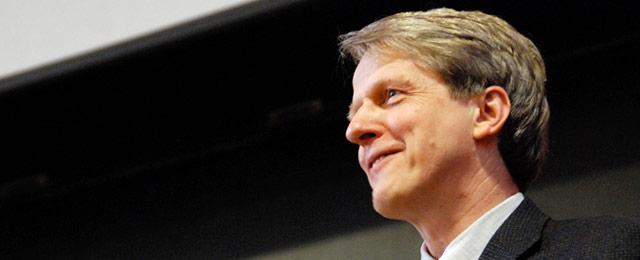
Mirrored from oyc.yale.edu · CC-BY-NC-SA-3.0 · Robert J. Shiller Arthur M. Okun Professor of Economics
Mirrored from: oyc.yale.edu · Yale University · Economics
Instructor: Robert J. Shiller Arthur M. Okun Professor of Economics · License: CC-BY-NC-SA-3.0
About this course
Financial institutions are a pillar of civilized society, supporting people in their productive ventures and managing the economic risks they take on. The workings of these institutions are important to comprehend if we are to predict their actions today and their evolution in the coming information age. The course strives to offer understanding of the theory of finance and its relation to the history, strengths and imperfections of such institutions as banking, insurance, securities, futures, and other derivatives markets, and the future of these institutions over the next century.
Course details
Course Structure
This Yale College course, taught on campus twice per week for 75 minutes, was recorded for Open Yale Courses in Spring 2008.
Texts
Brandeis, Louis D. Other People's Money and How the Bankers Use It , Augustus M. Kelley Publishers, Reprints of Economic Classics. New York, 1971.
Brealey, Richard, Stuart C. Myers, and Franklin Allen. Principles of Corporate Finance , 8th edition. McGraw-Hill/Irwin, 2005.
Douglas, William O. Democracy and Finance . New Haven: Yale University Press, 1940.
Fabozzi, Frank J., Franco Modigliani, Frank J. Jones, and Michael G. Ferri. Foundations of Financial Markets and Institutions , 4th ed. Boston, Massachusetts: Prentice Hall, 2010.
Hawtrey, R. G. The Art of Central Banking . London: Longmans, Green and Co., 1932.
O'Barr, William M. and John M. Conley. Fortune & Folly: The Wealth & Power of Institutional Investing . Homewood, Illinois: Business-One Irwin, 1992.
Shiller, Robert J. Irrational Exuberance , 2nd edition. New York: Doubleday, 2006.
--- The New Financial Order: Risk in the 21st Century . Princeton: Princeton University Press, 2003.
Siegel, Jeremy J. Stocks for the Long Run , 4th edition, New York: McGraw-Hill, 2008.
Sullivan, Teresa, Elizabeth Warren and Jay Lawrence Westbrook. The Fragile Middle Class: Americans in Debt . New Haven: Yale University Press, 2000.
Swensen, David. Pioneering Portfolio Management . New York: Free Press, 2000.
Unger, Peter. Living High and Letting Die: Our Illusion of Innocence . New York: Oxford University Press, 1996.
Requirements
Some facility with elementary algebra and calculus required. Course exams consist of roughly 50% math and theory problems and 50% facts and general understanding questions about financial markets.
Grading
Midterm exam 1: 20% Midterm exam 2: 30% Problem sets: 10% Final exam: 40%
Syllabus
1 section · 29 lectures · links open at oyc.yale.edu.
Course sessions
- Finance and Insurance as Powerful Forces in Our Economy and Society
- The Universal Principle of Risk Management: Pooling and the Hedging of Risks
- Technology and Invention in Finance
- Portfolio Diversification and Supporting Financial Institutions (CAPM Model)
- Insurance: The Archetypal Risk Management Institution
- Efficient Markets vs. Excess Volatility
- Behavioral Finance: The Role of Psychology
- Human Foibles, Fraud, Manipulation, and Regulation
- Guest Lecture by David Swensen
- Debt Markets: Term Structure
- Midterm Exam 1
- Stocks
- Real Estate Finance and Its Vulnerability to Crisis
- Banking: Successes and Failures
- Guest Lecture by Andrew Redleaf
- Guest Lecture by Carl Icahn
- The Evolution and Perfection of Monetary Policy
- Midterm Exam 2
- Investment Banking and Secondary Markets
- Professional Money Managers and Their Influence
- Brokerage, ECNs, etc.
- Guest Lecture by Stephen Schwarzman
- Forwards and Futures
- Stock Index, Oil and Other Futures Markets
- Options Markets
- Making It Work for Real People: The Democratization of Finance
- Okun Lecture: Learning from and Responding to Financial Crisis, Part I (Guest Lecture by Lawrence Summers)
- Okun Lecture: Learning from and Responding to Financial Crisis, Part II (Guest Lecture by Lawrence Summers)
- Final Exam