Open Yale Courses
ECON 251: Financial Theory
Mirrored from oyc.yale.edu · CC-BY-NC-SA-3.0 · John Geanakoplos James Tobin Professor of Economics
Mirrored from: oyc.yale.edu · Yale University · Economics
Instructor: John Geanakoplos James Tobin Professor of Economics · License: CC-BY-NC-SA-3.0
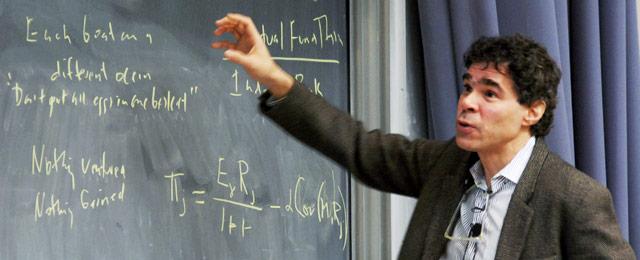
About this course
This course attempts to explain the role and the importance of the financial system in the global economy. Rather than separating off the financial world from the rest of the economy, financial equilibrium is studied as an extension of economic equilibrium. The course also gives a picture of the kind of thinking and analysis done by hedge funds.
Course details
Course Structure
This Yale College course, taught on campus twice per week for 75 minutes, was recorded for Open Yale Courses in Fall 2009.
Texts
Bodie, Zvi, and Robert C. Merton. Finance, Upper Saddle River, New Jersey: Prentice Hall, 2000.
Chance, Don M. An Introduction to Derivatives, 3rd edition, Fort Worth, Texas: The Dryden Press, Harcourt Brace College Publishers, 1995.
DeGroot, Morris H. Probability and Statistics, Reading, Massachusetts: Addison-Wesley Publishing Co., 1975.
Elton, Edwin J. and Martin J. Gruber. Modern Portfolio Theory and Investment Analysis, 5th edition, New York: John Wiley & Sons, Inc., 1995.
Fabozzi, Frank. Handbook of Mortgage Backed Securities, 6th edition, New York: McGraw-Hill, 2001.
Fabozzi, Frank J. Handbook of Fixed Income Securities, 6th edition, New York: McGraw-Hill, 2000.
Hull, John C. Options, Futures, and Other Derivatives, 5th edition, Upper Saddle River, New Jersey: Prentice Hall, 2002.
Jarrow, Robert and Stuart Turnbull. Derivative Securities, 2nd edition, Cincinatti, Ohio: South-Western College Publishing, 2000.
Luenberger, David G. Investment Science, New York: Oxford University Press, 1998.
Malkiel, Burton. A Random Walk Down Wall Street , New York: W.W. Norton, 1999.
Pliska, Stanley R. Introduction to Mathematical Finance . Discrete Time Models, Malden, Massachusetts: Blackwell Publishers, 1997.
Ross, Stephen, Randolph Westerfield, and Jeffrey Jaffe. Corporate Finance , New York: Irwin, McGraw Hill, 1999.
Sharpe, William F., Gordon J. Alexander, and Jeffery V. Bailey. Investments, 6th edition, Upper Saddle River, NJ: Prentice Hall, 1999.
Swensen, David F. Pioneering Portfolio Management. An Unconventional Approach to Institutional Investment, New York: The Free Press, 2000.
Taggart, Jr, Robert A. Quantitative Analysis for Investment Management, Upper Saddle River, New Jersey: Prentice Hall, 1996.
Tobin, James with Stephen Golub. Money, Credit, and Capital, Boston: Irwin-McGraw Hill, 1998.
Requirements
Math in the course Finance is a quantitative subject that can only be understood by solving concrete problems. But it uses mostly elementary mathematics. You need to be good at arithmetic (the distributive law is the basis for double entry bookkeeping), and be able to solve two or three simultaneous linear equations (x + y =10; x – y = 4. Solve for x and y). You must also be able to differentiate three elementary functions: dxn/dx =nxn-1; d ln x/dx = 1/x; deax/dx= aeax. The functions “log” and its inverse “exponential base e” are so important to finance because of continuous compounding of interest. Though they may be the most important functions in all of mathematics, they were discovered by bankers. You will also be taught how to use Excel.
Course reading The textbook readings are meant to clarify or elaborate material presented in class, or to give you an idea of alternative presentations of the same material. For example, we might discuss bonds, how they pay, and how to value them. The readings might cover the specifics of particular bond markets (local, state, different countries), how they are taxed etc. There is no official textbook. In the past I have used Corporate Finance , by former Yale professor Steve Ross and two co-authors, and two others, by Sharpe and Merton, both Nobel Prize winners in economics (for contributions to financial economics). Their books were regarded as insufficiently quantitative, but might be useful to browse in. Another very good book is by Luenberger, but it is a little too advanced for this course. I have listed a dozen or so good alternatives and supplements, to give you an idea of where you could read more if you become interested. None of these is required. You should be able to follow the course simply by attending the lectures, reading the web notes, and doing the problem sets.
Grading
Problem sets: 20% Midterm exam 1: 20% Midterm exam 2: 20% Final Exam: 40%
Syllabus
1 section · 26 lectures · links open at oyc.yale.edu.
Course sessions
- Why Finance?
- Utilities, Endowments, and Equilibrium
- Computing Equilibrium
- Efficiency, Assets, and Time
- Present Value Prices and the Real Rate of Interest
- Irving Fisher's Impatience Theory of Interest
- Shakespeare's Merchant of Venice and Collateral, Present Value and the Vocabulary of Finance
- How a Long-Lived Institution Figures an Annual Budget; Yield
- Yield Curve Arbitrage
- Dynamic Present Value
- Social Security
- Overlapping Generations Models of the Economy
- Demography and Asset Pricing: Will the Stock Market Decline when the Baby Boomers Retire?
- Quantifying Uncertainty and Risk
- Uncertainty and the Rational Expectations Hypothesis: Applications to Predicting Stock Prices, Default Probabilities, and Hyperbolic Discounting
- Backward Induction and Optimal Stopping Times
- Callable Bonds and the Mortgage Prepayment Option
- Modeling Mortgage Prepayments and Valuing Mortgages
- History of the Mortgage Market: A Personal Narrative
- Dynamic Hedging
- Dynamic Hedging and Average Life
- Risk Aversion and the Capital Asset Pricing Theorem
- The Mutual Fund Theorem and Covariance Pricing Theorems
- Risk, Return, and Social Security
- The Leverage Cycle and the Subprime Mortgage Crisis
- The Leverage Cycle and Crashes