Open Yale Courses
CHEM 125b: Freshman Organic Chemistry II
Mirrored from oyc.yale.edu · CC-BY-NC-SA-3.0 · J. Michael McBride Richard M. Colgate Professor Emeritus of Chemistry
Mirrored from: oyc.yale.edu · Yale University · Chemistry
Instructor: J. Michael McBride Richard M. Colgate Professor Emeritus of Chemistry · License: CC-BY-NC-SA-3.0
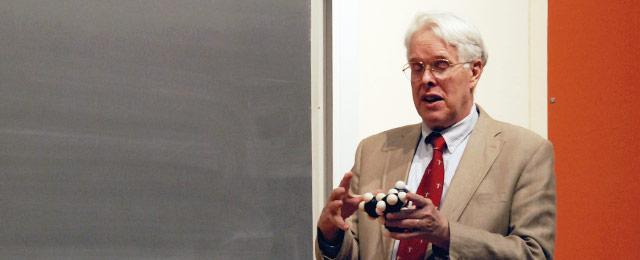
About this course
This is a continuation of Freshman Organic Chemistry I (CHEM 125a), the introductory course on current theories of structure and mechanism in organic chemistry for students with excellent preparation in chemistry and physics. This semester treats simple and complex reaction mechanisms, spectroscopy, organic synthesis, and some molecules of nature.
Course details
Course Structure
This Yale College course, taught on campus three times per week for 50 minutes, was recorded for Open Yale Courses in Spring 2011.
Texts
Reading assignments, problem sets, PowerPoint presentations, and other resources for this course can be accessed from Professor McBride's on-campus course website, which was developed for his Spring 2011 students: https://webspace.yale.edu/chem125
Optional Text: Organic Chemistry , 4th edition, Maitland Jones, Jr. and Steven A. Fleming, W. W. Norton & Company, New York, 2010.
Requirements
Problem sets, three midterm examinations, final examination
Grading
Midterm Examination 1: 100 points Midterm Examination 2: 100 points Midterm Examination 3: 100 points Final Examination: 300 points
Syllabus
1 section · 38 lectures · links open at oyc.yale.edu.
Course sessions
- Mechanism: How Energies and Kinetic Order Influence Reaction Rates
- Peculiar Rate Laws, Bond Dissociation Energies, and Relative Reactivities
- Rate and Selectivity in Radical-Chain Reactions
- Electronegativity, Bond Strength, Electrostatics, and Non-Bonded Interactions
- Solvation, H-Bonding, and Ionophores
- Brønsted Acidity and the Generality of Nucleophilic Substitution
- Nucleophilic Substitution Tools - Stereochemistry, Rate Law, Substrate, Nucleophile, Leaving Group
- Solvent, Leaving Group, Bridgehead Substitution, and Pentavalent Carbon
- Pentavalent Carbon? E2, SN1, E1
- Cation Intermediates – Alkenes: Formation, Addition, and Stability
- Carbocations and the Mechanism of Electrophilic Addition to Alkenes and Alkynes
- Nucleophilic Participation During Electrophilic Addition to Alkenes: Halogen, Carbene, and Borane
- Addition to Form Three-Membered Rings: Carbenoids and Epoxidation
- Epoxide Opening, Dipolar Cycloaddition, and Ozonolysis
- Metals and Catalysis in Alkene Oxidation, Hydrogenation, Metathesis, and Polymerization
- Isoprenoids, Rubber, and Tuning Polymer Properties
- Alkynes; Conjugation in Allylic Intermediates and Dienes
- Linear and Cyclic Conjugation Theory; 4n+2 Aromaticity
- Aromatic Transition States: Cycloaddition and Electrocyclic Reactions
- Electronic and Vibrational Spectroscopy
- Functional Groups and Fingerprints in IR Spectroscopy; Precession of Magnetic Nuclei
- Medical MRI and Chemical NMR
- Diamagnetic Anisotropy and Spin-Spin Splitting
- Higher-Order Effects, Dynamics, and the NMR Time Scale
- C-13 and 2D NMR – Electrophilic Aromatic Substitution
- Aromatic Substitution in Synthesis: Friedel-Crafts and Moses Gomberg
- Triphenylmethyl and an Introduction to Carbonyl Chemistry
- Mechanism and Equilibrium of Carbonyl Reactions
- Imines and Enamines; Oxidation and Reduction
- Oxidation States and Mechanisms
- Periodate Cleavage, Retrosynthesis, and Green Chemistry
- Measuring Bond Energies: Guest Lecture by Prof. G. Barney Ellison
- Green Chemistry; Acids and Acid Derivatives
- Acids and Acid Derivatives
- Acyl Insertions and α-Reactivity
- α-Reactivity and Condensation Reactions
- Proving the Configuration of Glucose and Synthesizing Two Unnatural Products
- Review: Synthesis of Cortisone